

A Front Range plant profile for homeowners: how Rocky Mountain penstemon grows, what care it needs, and where its blue spikes fit in a water-wise Boulder County landscape, from CSU Extension and other sourced references.


Lorem ipsum dolor sit amet, consectetur adipiscing elit. Suspendisse varius enim in eros elementum tristique. Duis cursus, mi quis viverra ornare, eros dolor interdum nulla, ut commodo diam libero vitae erat. Aenean faucibus nibh et justo cursus id rutrum lorem imperdiet. Nunc ut sem vitae risus tristique posuere.
Picture a sunny bed in Superior in late May. Gray boulders, a few clumps of fine grass, and one block of deep blue flower spikes that bees will not leave alone. That blue is often Rocky Mountain penstemon. This Front Range plant profile covers how it grows, what care it needs, and where it earns a place in water-wise landscaping in Colorado. Green Landscape Solutions designs and builds native plantings for Boulder County homes, so we checked every growing fact against the sources listed at the bottom.
Rocky Mountain penstemon is a native perennial that grows from the foothills to the mountains of Colorado. Wild Ones Front Range lists its native range to 11,000 feet and its habitat as montane, foothills, pinyon-juniper and sagebrush country. That makes it a good match for dry Front Range beds.
The City of Boulder lists it among its native plants, noting that planted in clumps it produces "show-stopping clusters of tall indigo and lavender flowers, much loved by insects." The city also calls it transplant hardy.
Wild Ones Front Range describes it as "one of the longest-lived and least fussy of the native Penstemons." It keeps an evergreen basal rosette of leaves, according to New Mexico State University (NMSU), so the plant is not a bare spot in winter.
Be careful at the nursery. The City of Boulder warns that many non-native penstemons are sold, and advises checking the scientific name. Look for Penstemon strictus on the tag.
Expect a clump 15 to 30 inches tall and 1 to 3 feet wide, per Wild Ones Front Range. The City of Boulder gives a height of 1 to 2 feet. NMSU, writing about the 'Bandera' selection, reports flower stalks of 8 to 23 inches and a basal diameter of about 20 inches.
These numbers vary by source and soil. Plan for the larger figure when you set spacing, so mature clumps do not crowd their neighbors.

Give it sun, drainage, and spring moisture. CSU Extension says most penstemons need at least six hours of full sun and good soil aeration, and that they do not perform well in compacted soil. Wild Ones lists full sun to light shade and adaptable, well-drained soil.
CSU Extension notes that penstemons from wetter places or high elevations often do better with some afternoon shade. Rocky Mountain penstemon tolerates light shade, per Wild Ones, so a bed with morning sun and a little afternoon relief can work.
Heavy, compacted soil is the main risk. CSU Extension calls rock gardens and xeriscapes "ideal" settings. In clay, plan to loosen the soil and raise the bed slightly so water drains away from the crown.
This is a low-water plant with one catch. CSU Extension lists Rocky Mountain penstemon as needing only natural precipitation, but says it requires ample spring moisture and suggests supplemental water in spring if conditions are dry. Overwatering after flowering can lead to crown rot.
So water in spring if it is dry, then ease off once the bloom ends. That pattern is easy to set up with a drip zone on a timer. Our smart irrigation controller guide explains how.
Plants from the nursery are the fastest route. NMSU says flowering does not generally occur in the first year of growth from seed. If you want to sow seed, NMSU advises sowing it a quarter to a half inch deep in fall or early winter and keeping it moist so it stratifies naturally. Wild Ones says the seed needs cold stratification at 40 degrees F for three months. Late November falls inside that window.
Care is light. CSU Extension says most penstemons need no fertilizer in typical garden soils and only dead-heading after flowering. The decision is how many seed stalks to leave.
Rocky Mountain penstemon self-sows prolifically, per Wild Ones. That is a gift in a meadow bed and a chore in a formal one. Pull extra seedlings in spring.
CSU Extension also lists problems: grasshoppers and flea beetle larvae can eat plants, rust fungi can shorten their lives, and root and crown rot in wet soil can make plants collapse. NMSU reports fusarium wilt on 'Bandera' growing on irrigated sandy loam. None of the sources we read give a deer rating for this plant, so we will not promise one.
Use it for a hit of true blue in late spring, set against stone and fine grasses. Plant it in clumps, as the City of Boulder suggests, rather than single plants. A group of three to five reads as a block of color. A single plant reads as an accident.
Here are three ways we would use it in a Boulder County yard:
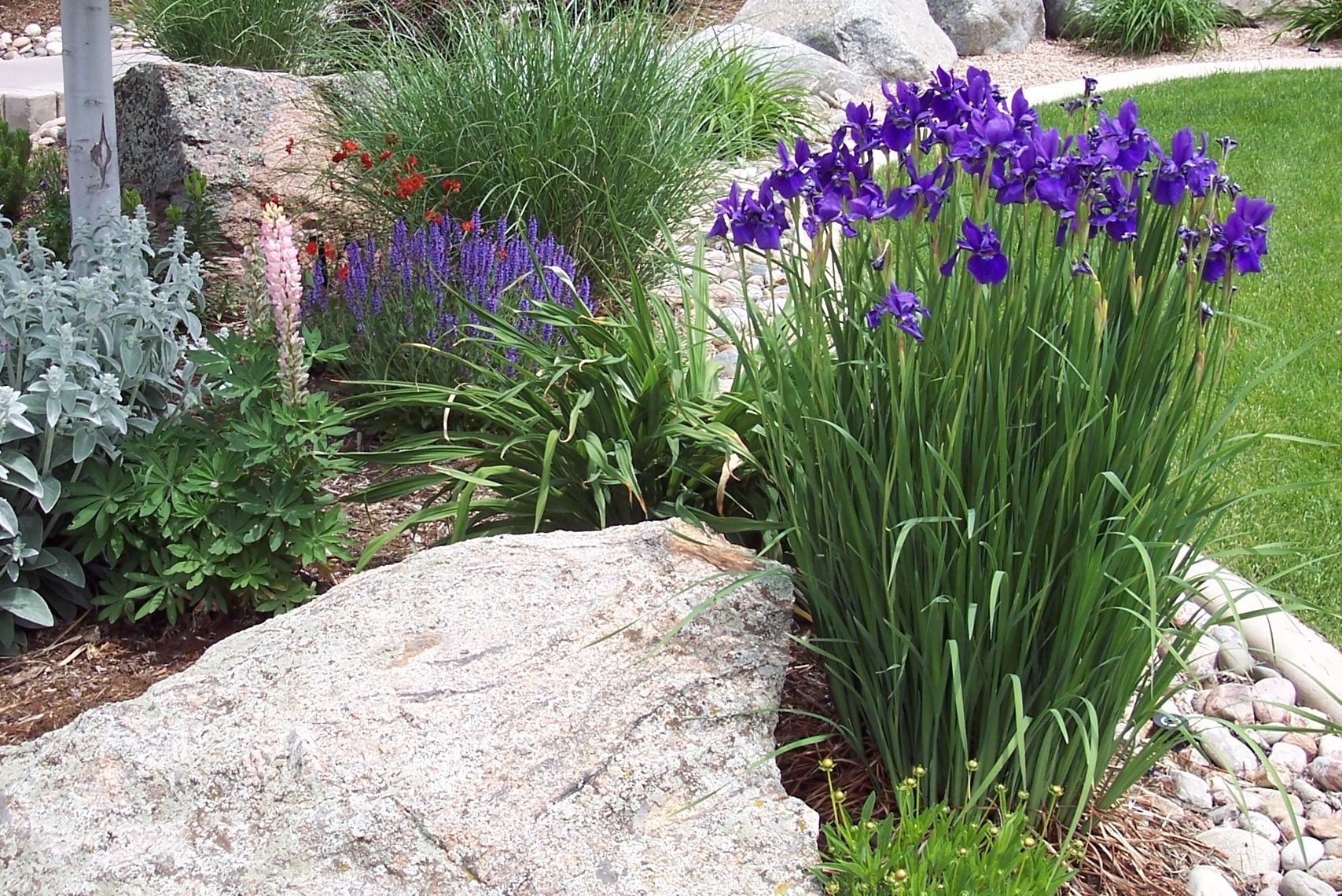
Photo note: the purple bloom here is Siberian iris, not penstemon. We show the bed because it makes the same design point: saturated purple-blue against gray granite and fine grass, with a mulch and river-rock edge around it.
Layering matters. Put the taller grass behind, the penstemon in the middle, and a low silver-leaved plant in front, as in the photo. The varied heights and leaf textures keep the bed interesting once the flowers fade.
In Superior, it fits a sunny, well-drained bed that gets little supplemental water. Used as part of a native plants Boulder County palette, it supplies late-spring color and pollinator value while the grasses and stone carry the other seasons.
A Green design looks at sun, soil, drainage, and irrigation together, then builds the plan with the same team. Learn more about our water-wise planting and garden design service and our xeriscaping page. The Superior landscape design page covers how we work in town.
Green Landscape Solutions has served Boulder County since 2002 and has completed more than 1,000 projects. We plan plantings in Boulder and nearby towns, including Superior, Louisville, Lafayette, Erie, and Gunbarrel. See the full list on our service areas page.
Want native color that fits your sun, soil, and water? Call (720) 468-0987 or Tell Us About Your Property. We will talk through the look you want and what your site can support.
Wild Ones Front Range lists bloom from mid-spring to early summer, with a possible rebloom in fall. NMSU records peak flowering between mid-May and mid-June in its trials. Plants grown from seed generally do not flower in their first year.
Very little once established. CSU Extension lists it as needing only natural precipitation but ample spring moisture, and suggests supplemental water in spring if conditions are dry. Overwatering after flowering can lead to crown rot.
Remove spent flower stalks after bloom. NMSU says this ensures flowers the following year, and CSU Extension says it can increase lifespan. Leave a few seed capsules if you want the plant to reseed.
It spreads by seed, not by runners. Wild Ones Front Range says it self-sows prolifically in gardens. Pull extra seedlings in spring if you want to keep a bed tidy.
Well-drained soil. CSU Extension says penstemons need good soil aeration and drainage and do not perform well in compacted soil. In clay, loosen the soil and raise the bed slightly so water drains from the crown.
