
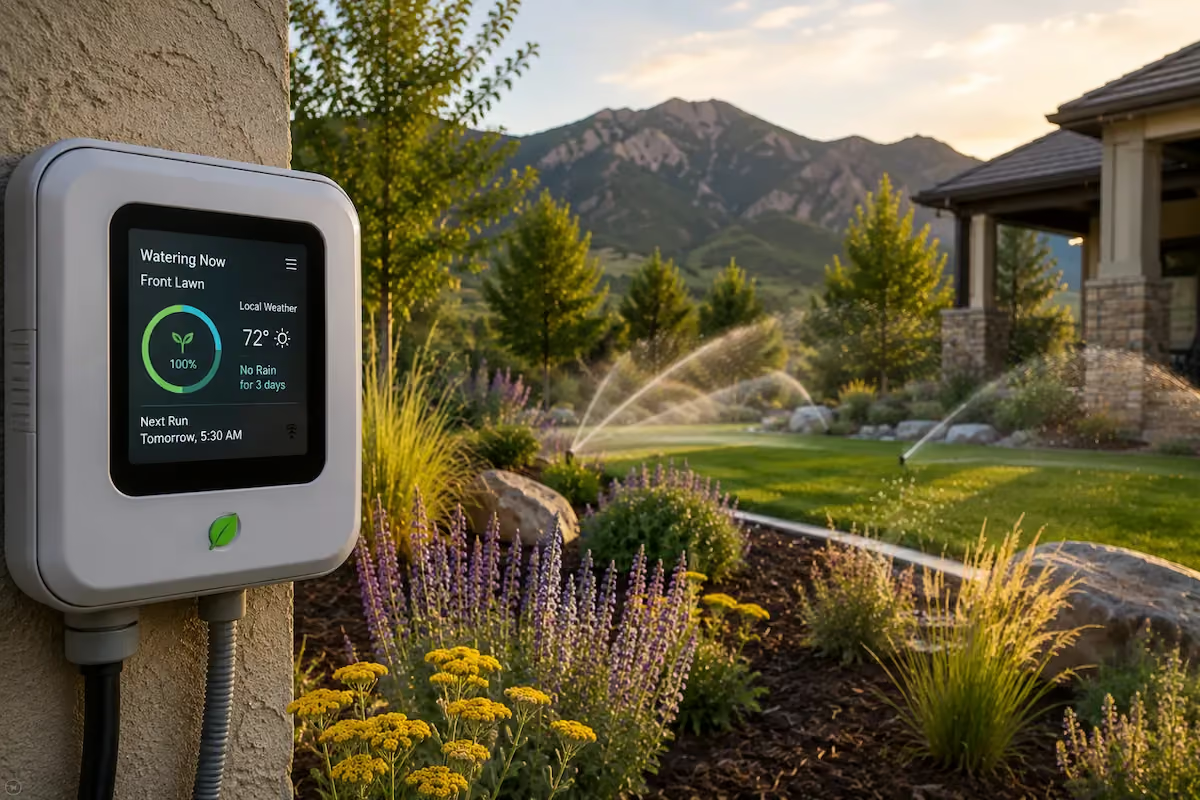

Your old sprinkler timer does one thing: it runs on a fixed schedule, rain or shine. A smart controller does something better. It watches the weather and waters only when your landscape actually needs it. Here you'll learn how smart controllers work, how much water they save, and what Colorado's new law means for homeowners. Watering smarter starts with the right controller.


Lorem ipsum dolor sit amet, consectetur adipiscing elit. Suspendisse varius enim in eros elementum tristique. Duis cursus, mi quis viverra ornare, eros dolor interdum nulla, ut commodo diam libero vitae erat. Aenean faucibus nibh et justo cursus id rutrum lorem imperdiet. Nunc ut sem vitae risus tristique posuere.
Your old sprinkler timer does one thing: it runs on a fixed schedule, rain or shine. A smart controller does something better. It watches the weather and waters only when your landscape actually needs it. On the Front Range, where every gallon counts and new state rules now favor this technology, that difference matters.
Here, you will learn what smart irrigation controllers are, how they work, how much water they save, and what Colorado's new law means for homeowners. Watering smarter starts with the right controller.
A smart irrigation controller is an advanced timer that decides when and how much to water on its own. A traditional clock-based controller follows a preset schedule no matter the weather, so it runs even after a soaking rain. A smart controller adjusts automatically.
The result is water applied only when plants need it. That saves water, lowers bills, and protects your landscape from the overwatering that harms many ornamental plants.
The EPA notes that more than 28 million homes have in-ground sprinkler systems, most still running on clock-based timers set for peak summer and rarely adjusted. Smart controllers solve that problem by matching watering to real conditions.
Smart controllers fall into two main categories. Both aim to match watering to a plant's true needs.
Weather-based controllers, also called WBICs, use local weather and landscape data to tailor each watering schedule. They factor in rainfall, temperature, and humidity, then adjust run times or skip a cycle when rain is expected. Many connect to Wi-Fi and can be managed from a phone.
These controllers work on the principle of evapotranspiration, or ET. ET is the water lost from soil through evaporation plus the water used by the plant. By estimating ET, the controller replaces only the water the landscape has actually lost.
Soil moisture-based controllers, or SMSs, rely on sensors buried in the ground. The sensor reads moisture at the root zone and overrides scheduled watering when the soil is already wet enough. Some are standalone units, and others plug into an existing clock-based controller to make it smarter.
Water savings are the main reason to upgrade. The numbers come from the EPA's WaterSense program, the trusted federal label for water efficiency.
Claim
Source
WaterSense-labeled products are at least 20 percent more water-efficient than standard models
EPA WaterSense
A WaterSense soil moisture controller can save an average home more than 15,000 gallons a year
EPA WaterSense
As much as 50 percent of outdoor water use is wasted through inefficient irrigation
EPA estimate
Beyond the water itself, there is a plant-health payoff. Traditional controllers tend to overwater to keep plants alive, but overwatering is a leading cause of trouble with ornamental plants. Replacing or treating damaged plants costs far more than the water saved.
This is the part Front Range homeowners need to know. As of January 1, 2026, Colorado House Bill 1161 requires irrigation products sold in the state to include WaterSense-labeled irrigation controllers, along with spray bodies that have pressure regulation and a built-in check valve.
In plain terms, the smart controller is no longer just a nice upgrade in Colorado. It is the standard the state has chosen for new and replacement irrigation equipment. The law reflects Colorado's long-standing focus on water conservation in a semi-arid climate.
For homeowners, this makes the choice simple. When you install or replace a controller, look for the WaterSense label to stay current with state requirements and get certified efficiency.
Colorado's climate is built for this technology. Our semi-arid conditions, low rainfall, and hot, dry summers mean overwatering wastes a precious resource. Smart controllers respond to those exact swings, dialing back during a wet stretch and ramping up in a heat wave.
They also pair well with the water-wise practices our region rewards. Group plants with similar water needs into zones, combine a smart controller with drip irrigation, and lean on drought-tolerant plantings. Together these steps cut water use without sacrificing a healthy landscape.
Picking the right controller comes down to a few clear steps.
Smart irrigation controllers do what old timers cannot: they water based on real conditions, not a rigid clock. For Front Range homeowners, the benefits stack up as lower water bills, healthier plants, and less waste in a climate where water is always at a premium. With Colorado's HB 1161 now in effect, a WaterSense-labeled controller is also the state's chosen standard.
If your system still runs on a basic timer, an upgrade is one of the most cost-effective improvements you can make. Start by checking your current controller, counting your zones, and asking your utility about rebates. Our team designs, installs, and upgrades irrigation systems across Boulder County and can help you water smarter.
Ready to upgrade your irrigation? Call Green Landscape Solutions at (720) 468-0987 or visit greenlandscapellc.com to schedule a consultation.
