

Eight small jobs to finish before the ground freezes, each with the reason behind it. In Niwot and across Boulder County, late October is the last easy window to get a yard ready for winter. This checklist follows CSU Extension and PlantTalk Colorado guidance for fall landscaping in Colorado.


Lorem ipsum dolor sit amet, consectetur adipiscing elit. Suspendisse varius enim in eros elementum tristique. Duis cursus, mi quis viverra ornare, eros dolor interdum nulla, ut commodo diam libero vitae erat. Aenean faucibus nibh et justo cursus id rutrum lorem imperdiet. Nunc ut sem vitae risus tristique posuere.
Green Landscape Solutions, a design-build team serving Boulder County since 2002, works with homeowners in Niwot, Louisville, Lafayette, Erie, and nearby towns. Late October is when small habits decide how a yard looks in April. The list below keeps each task short and gives the reason behind it. Every guideline comes from CSU Extension, PlantTalk Colorado, NOAA, or a Colorado Master Gardener column, and each one is linked in the Sources section.
Water trees and shrubs during dry, mild stretches. Deal with fallen leaves. Mulch around woody plants. Finish shutting down irrigation. Then look at bulbs and perennials. Most of this takes a weekend, and none of it needs special equipment.
For a local reference point, NOAA's Physical Sciences Laboratory lists Boulder's average first fall freeze as October 6, based on records from 1948 to the present. If your yard has already seen a hard freeze, you are not behind. You are on schedule.
Yes, during dry stretches. CSU Extension says to water about once or twice a month when air and soil are above 40 degrees F and there is no snow cover. Water at midday so the moisture soaks in before nighttime freezes. Shrubs can benefit from this from October through March in dry winters.
PlantTalk Colorado says recent transplants, evergreens, and shallow-rooted trees such as lindens, birches, and Norway and silver maples are most at risk in dry winters. It also advises watering when leaves begin to fall, so plants enter winter with enough soil moisture.
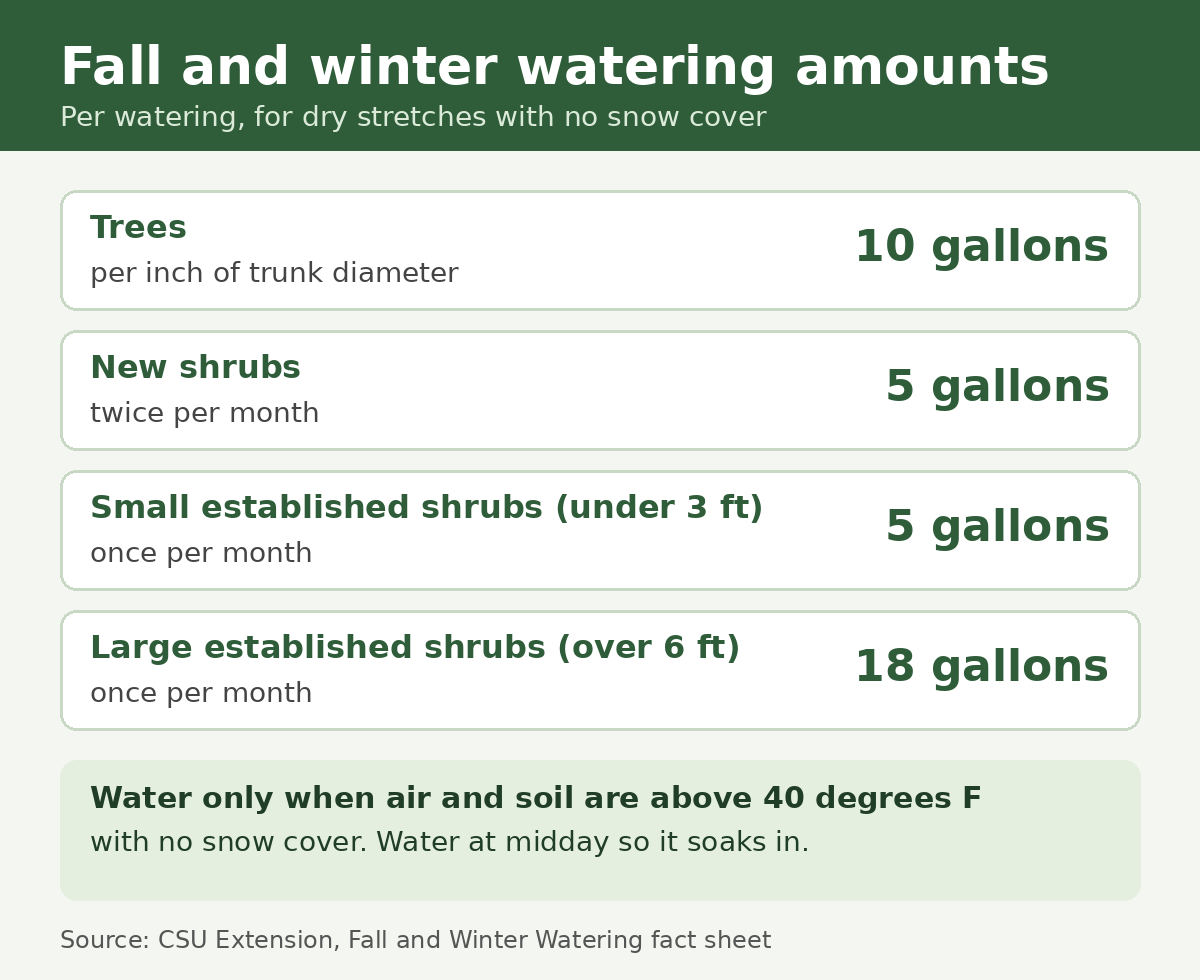
CSU Extension gives specific amounts. Measure a tree trunk 6 inches above the ground to get its diameter. CSU also says to reduce amounts to account for precipitation.
| Plant | Amount per watering | How often |
|---|---|---|
| Trees | 10 gallons per inch of trunk diameter | Once or twice a month in dry spells |
| Newly planted shrubs | 5 gallons | Twice per month |
| Small established shrubs (under 3 feet) | 5 gallons | Once per month |
| Large established shrubs (over 6 feet) | 18 gallons | Once per month |
A two-inch tree, for example, needs 20 gallons per watering. Water slowly so it soaks about 12 inches deep, and spread the water under the dripline and beyond. CSU Extension lists sprinklers, a deep-root fork or needle, a soaker hose, or a soft spray wand as acceptable tools. If you use a fork or needle, insert it no deeper than 8 inches.
New lawns, late-planted perennials, and plants on south or west exposures get missed most often. CSU Extension notes that newly seeded or sodded lawns are especially susceptible to winter damage. It also says south- and west-facing lawns and windy sites dry out faster.
Plants near walls, fences, and buildings can take extra damage from reflected heat. CSU Extension also advises winter watering for late-planted perennials and bare-root plants. On exposed sites, pair watering with mulch to limit freeze-thaw cracking that exposes roots.
Walk your own yard and note which spots match these descriptions. Those are the beds and lawn edges to check first on each mild, dry day this winter.
Mowing is often enough. CSU Extension suggests setting the mower to its highest setting and making a couple of passes, ideally over dry leaves. The test is simple: if you can still see grass after mulching, you are done. Chopped leaves return nutrients and moisture to turf roots.
For thicker piles, move leaves into garden beds. CSU Extension suggests a 6 to 8 inch layer of leaves on vegetable beds, moistened and left to break down over winter. It also says to leave leaf litter undisturbed in beds until at least mid-April to mid-May, so native bumblebees can emerge. Keep leaves off the lawn itself, because a thick mat can smother turf.
Three jobs pay off: mulch woody plants, decide what to do with perennials, and decide what to do with ornamental grasses. A Colorado Master Gardener column in The Gazette suggests 2 inches of wood-based mulch around trees and shrubs to conserve moisture. CSU Extension also says mulch helps woody plants hold soil moisture.
Cleanup can happen in fall or spring. If you deadhead, leave green foliage in place, because it sends stored energy to the roots for next season. Leaving seed heads standing feeds birds in winter. Ornamental grasses can be pruned in fall or left up for winter interest.
Good design leaves room for both choices. Standing grasses and seed heads add texture to a winter garden. A cut-back bed looks tidy. Pick one approach per bed so the yard reads as intentional.
It is the last call. PlantTalk Colorado gives mid-September to late October as the planting window at most elevations, so roots form before the ground freezes. Plant at a depth of about three to four times the bulb's diameter. In sandy soil, go about 2 inches deeper. If the soil is still workable and you have bulbs in a bag, plant them now.
Let the foliage die back naturally after spring bloom. It feeds the bulb for next year. Planting annuals or tall groundcovers nearby can hide the fading leaves.
Not for long. PlantTalk Colorado says not to run sprinkler systems in winter, and to disconnect and drain hoses after each use. A Colorado Master Gardener column in The Gazette adds that draining the system reduces freeze damage. We cover the timing and CSU Extension's controller and backflow guidance in When to Winterize Sprinklers in Colorado.
For trees and shrubs, watering on mild days follows the CSU guidance above. Our post Watering in the Fall: Why Colorado Landscapes Need It Most explains why fall moisture matters before the ground freezes.
A checklist helps a yard get through winter. It does not fix drainage problems, replace worn-out plantings, or solve a layout that never worked. If the same bed struggles every year, the cause may be design rather than neglect. Plant choice, grading, and irrigation layout all matter.
That is where a design-build team helps. Green Landscape Solutions offers landscape maintenance and water-wise planting and garden design for Boulder County properties. If you want a second opinion on a yard you have been fighting, winter is a good time to start planning for spring.
Green Landscape Solutions serves yards across the Front Range. See our location pages for Niwot, Louisville, Lafayette, Erie, Superior, and Gunbarrel. You can also see the full service area, including Boulder.
Want a yard that handles winter without a scramble every October? Call (720) 468-0987 or Tell Us About Your Property.
CSU Extension suggests about once or twice a month during dry stretches with no snow cover. Water only when air and soil temperatures are above 40 degrees F, and water at midday so moisture soaks in before nighttime freezes. PlantTalk Colorado adds that you should water again if four weeks pass without snow cover.
Mowing often works. CSU Extension suggests setting the mower to its highest setting and making a couple of passes, ideally on dry leaves. If you can still see grass after mulching, you are done. If leaves are too thick to mow, move them to garden beds or a compost bin.
PlantTalk Colorado lists mid-September to late October as the planting window at most elevations, so roots can form before the ground freezes. Late October is the end of that window. Plant at a depth of about three to four times the bulb diameter if the soil is still workable.
Either works, according to a Colorado Master Gardener column in The Gazette. Cutting back in fall tidies the garden. Leaving seed heads and ornamental grasses standing gives birds winter food and adds winter interest. If you deadhead, leave green foliage in place so the plant can send stored energy to its roots.
PlantTalk Colorado says not to run sprinkler systems in winter and to disconnect and drain hoses after use. Our separate guide on when to winterize sprinklers in Colorado covers timing and the CSU Extension advice in more detail.
