


Colorado fall weather swings fast, so the safe time to winterize sprinklers is before the first hard freeze. Here is how Boulder County homeowners should time it, clear the lines, and handle the backflow device.


Lorem ipsum dolor sit amet, consectetur adipiscing elit. Suspendisse varius enim in eros elementum tristique. Duis cursus, mi quis viverra ornare, eros dolor interdum nulla, ut commodo diam libero vitae erat. Aenean faucibus nibh et justo cursus id rutrum lorem imperdiet. Nunc ut sem vitae risus tristique posuere.
The best time to winterize a sprinkler system in Colorado is before the first hard freeze, when overnight lows stay below 28 degrees F for several hours. For homeowners in Boulder, Erie, Lafayette, Louisville, Superior, and Longmont, that puts the practical deadline in early to mid October. If your system is still on, shut it down this week.
Green Landscape Solutions designs and builds irrigation systems across Boulder County. This guide covers when to shut down, how to clear the lines the way CSU Extension recommends, the backflow mistake that costs homeowners money, and when to call a professional.
Winterize before the first hard freeze, when overnight temperatures drop below 28 degrees F for several hours. Some Colorado water districts recommend finishing by October 1. Turning your system off a little early will not hurt your lawn, and it helps you avoid costly spring repairs.
Fall in Colorado is hard to time. CSU Extension's PlantTalk Colorado notes that day and night temperatures can swing widely within a short period, so you are weighing damage to the system against the need to water a dry landscape. Lawns usually go dormant in late October or early November and need little to no water through winter, so the risk and the payoff both lean toward shutting down early.
NOAA's Physical Sciences Laboratory tracks the first day each fall that Boulder drops to 32 degrees F or lower. Since 1948, the average date is October 6. In about one year out of four, that first frost came on or before September 27. The earliest on record in that data is September 8, 2020. By October 15, about three years out of four have already had their first frost.
A 32 degree reading is not yet a hard freeze, but it is the warning. Treat it as your signal to finish the job, not start it.
Higher elevations tend to freeze first. If your property sits up toward Nederland or Estes Park, plan to winterize earlier than neighbors down in Longmont or Erie.
Water left in sprinkler lines expands as it freezes and can burst pipes and fittings, crack valves, and split sprinkler and pump cases. CSU Extension explains that water increases in volume by about one-eleventh when it turns to ice, which is enough force to break most irrigation components.
You often do not find out until spring, when you turn the system on and something leaks or a zone loses pressure.
Shut off the water, blow out every zone with compressed air, drain the backflow device by hand, and insulate what sits above ground. CSU Extension says not to rely on drain valves alone, so the air blowout is the step that matters most.
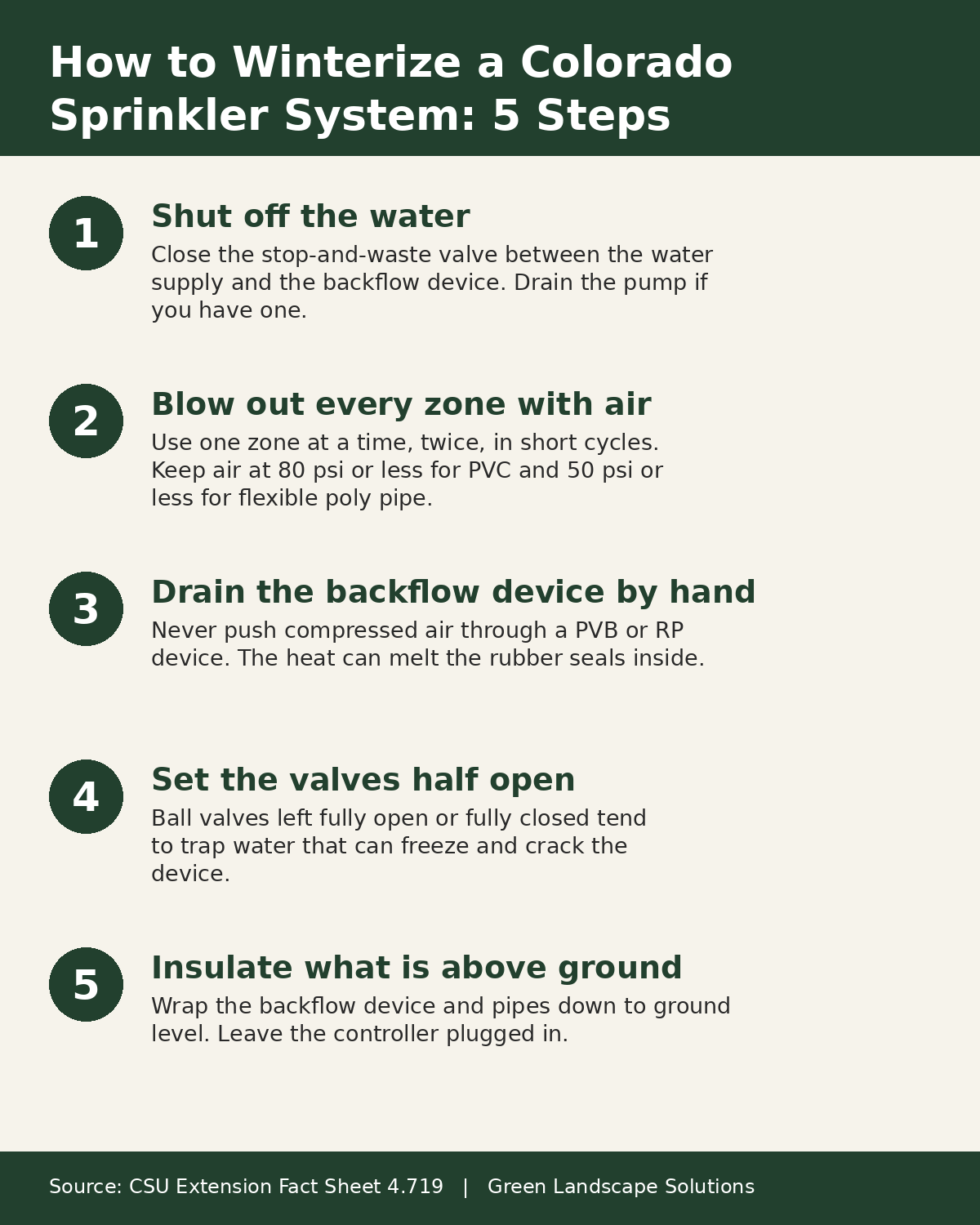
Close the stop-and-waste valve or other drain installed between the water supply and the backflow device. It may be in a basement, a crawlspace, or an underground valve box, sometimes several feet down. Do not force it. If the system has a pump, drain it and store it inside, or wrap it.
Connect the compressor to the downstream blowout fitting. Start one zone at a time at the controller, the same way you normally irrigate, and blow it out with air. CSU Extension recommends two short cycles per zone rather than one long one, and says not to keep blowing a zone that is already dry. Moving air through dry pipe creates friction and heat that can damage fittings.
A backflow preventer is the device that keeps irrigation water from flowing back into your drinking water. CSU Extension says pressure vacuum breaker (PVB) and reduced pressure (RP) devices must never be blown out with compressed air, because the rubber seals inside can melt from the heat. Drain them by hand instead. After the blowout, work the ball valves and test cocks back and forth a few times, then leave the ball valves about half open for the winter. Valves left fully open or fully closed tend to trap water that expands and cracks the device.
PlantTalk Colorado suggests wrapping the backflow preventer with insulation covered in plastic, including the pipes down to ground level, and securing it with duct tape. A well-wrapped preventer can also keep the system usable a little longer into fall.
CSU Extension says not to unplug the controller. Heat from the transformer helps keep moisture out, and it recommends running a minimum cycle once a week so the valve solenoids do not stick.
Manual and automatic drain valves rely on gravity. They only work if the system was laid to grade with no humps that trap water, and CSU Extension notes that buried pipes shift over time and cannot be inspected once drained. Systems with electric valves must be blown out with air, since there is no other way to clear the water from the top of the valve diaphragm.
PlantTalk Colorado says the same thing in plainer terms: lines settle and create low spots, and those spots benefit from a blowout even when the system has inline drains.
You can, but you need the right compressor and you have to stay within the limits. CSU Extension says air volume matters as much as air pressure. Too little air rides over the top of the water and leaves it in low spots. Too much pressure can blow nozzles off and damage pipe. Keep pressure at 80 psi or less for rigid PVC and 50 psi or less for flexible poly pipe.
CSU gives a sizing rule: divide the gallons per minute of your largest zone by 7.5 to find the cubic feet per minute of air you need. A zone that flows 20 gallons per minute needs a compressor delivering about 2.7 cubic feet per minute. CSU also says to wear eye protection. PlantTalk Colorado says most homeowners are better off hiring a professional with the right equipment.
No. One Colorado water district notes that turning a system off a little earlier than normal should not affect your lawn's health, and the lawn comes back green in spring. Most lawns are heading dormant by late October anyway.
For the watering side of the year, see our Boulder County guide to smart irrigation controllers.
Drainage problems often start at the design stage. Before a new system goes in, ask whether the lines are graded to drain, whether there is a stop-and-waste valve ahead of the backflow device, and whether the backflow device has blowout fittings on the downstream side. CSU Extension says one will need to be added if it is missing before the system can be blown out safely.
Green Landscape Solutions plans irrigation alongside grading, planting, and hardscape, so those questions get answered before anything goes in the ground. Learn more about our irrigation and sprinkler system installation work, or how design-build keeps it all under one team.
We design and build landscapes in Boulder, Gunbarrel, and Niwot, and in nearby communities including Erie, Lafayette, Louisville, Superior, Longmont, and Broomfield. You can see every town we serve on our service areas page.
Shut off the water, blow out every zone, drain the backflow device by hand, and wrap what sits above ground before the first hard freeze. When in doubt, call a professional for the blowout.
Green Landscape Solutions has been designing and building landscapes across Boulder County since 2002, with more than 1,000 completed projects. Call (720) 468-0987 or visit our contact page to talk through your property.
The City of Englewood describes the first hard freeze as overnight temperatures below 28 degrees F for several hours. In Boulder, NOAA records show the first reading at or below 32 degrees F arrives around October 6 in an average year, so plan to finish by early to mid October.
Plan on winterizing every fall. CSU Extension says buried pipes shift over time and there is no way to inspect them after draining, so blowing the lines out with compressed air each year is the only sure way to clear them.
Yes, if you have the right compressor and know the limits. CSU Extension says air volume matters as much as pressure, and too much pressure can blow off nozzles or damage pipe. Many homeowners are better off hiring a professional.
No, leave it plugged in. CSU Extension says the transformer's heat helps keep moisture out of the controller, and it recommends running a minimum cycle once a week so the valve solenoids do not stick.
Inspect the system for leaks, cracks, and misaligned heads. Close the backflow device's test cocks and ball valves before you turn the water on, then open the ball valves slowly to avoid water hammer, as CSU Extension advises.
