
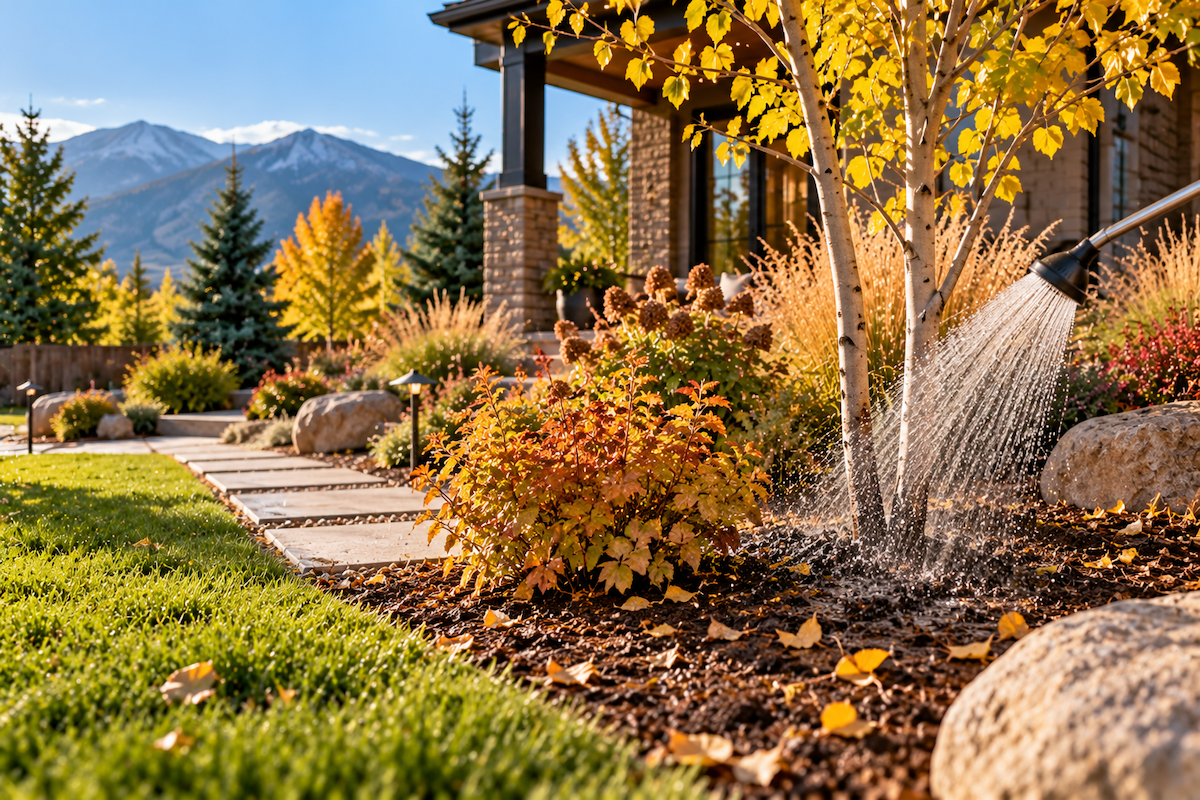


Lorem ipsum dolor sit amet, consectetur adipiscing elit. Suspendisse varius enim in eros elementum tristique. Duis cursus, mi quis viverra ornare, eros dolor interdum nulla, ut commodo diam libero vitae erat. Aenean faucibus nibh et justo cursus id rutrum lorem imperdiet. Nunc ut sem vitae risus tristique posuere.
Here is the sequence that kills more Boulder County plants than any pest or disease. Sprinklers get blown out in October. The leaves drop. Everything looks finished for the year. Nobody waters again until the system is turned back on in April. That is roughly six months without water, and plants do not stop needing it just because they stopped growing.
Watering in the fall is the single most overlooked task in Colorado landscape care, and it is also one of the cheapest forms of insurance you can buy. This guide covers why fall and winter watering matters so much along the Front Range, exactly when to water and when not to, how much each type of plant needs, and how to do it once your irrigation system is shut down for the season.
Yes. In Colorado, fall watering is not optional maintenance, it is survival maintenance. Dry air, low precipitation, thin soil moisture, and swinging temperatures define fall and winter across much of the state, and there is often little or no snow cover to supply moisture from October through March. Under those conditions, CSU Extension is clear that trees, shrubs, perennials, and lawns can be damaged without supplemental water. Water when air and soil temperatures are above 40 degrees F and the ground is not frozen, roughly once or twice a month during dry periods.
The counterintuitive part is that dormancy does not protect a plant. It slows things down. It does not seal the plant off from the atmosphere.
CSU Extension horticulture specialist Alison O'Connor puts it plainly: dormant plants still need water, because even without leaves they continue losing it. On warm days, sap and water keep moving inside trees. Root growth, nutrient transport, and photosynthesis all continue at some level through the cold months. The plant is running on a lower setting, not switched off.
Evergreens make this obvious. A spruce or pine holds its needles all winter and transpires through them the entire time. Every dry, sunny, windy January afternoon pulls moisture out of those needles, and if the roots cannot replace it, the needles brown from the tips back.
This is the practical math that makes fall watering non-negotiable in Colorado. Most Front Range irrigation systems get blown out somewhere between late September and late October, and they do not come back online until April. That is close to six months.
No landscape plant in a semi-arid climate survives six dry months in good condition without help. Established, deeply rooted, drought-adapted plants may coast through. Anything planted in the last year or two will not.
This is why the problem persists. Injury or death to parts of a root system during a long dry fall or winter often produces no visible symptom at the time. The plant leafs out in spring on stored energy and looks perfectly normal. Then temperatures rise in late spring or summer, demand outruns what the damaged roots can deliver, and the plant declines or dies.
By then it is June and the homeowner is looking for a disease or an insect. The actual cause was a dry December. Weakened plants are also more susceptible to insect and disease problems, so the two often show up together, which muddies the diagnosis further.
There is a common and costly assumption that a drought year means you should water less across the board. For fall and winter watering, the opposite is true.
Limited summer rainfall and watering restrictions deplete subsurface soil moisture. CSU Extension notes that after a dry, restricted season, people who dig down often find very little moisture at the 8 to 12 inch depth where most tree roots live. Plants enter winter with an empty tank rather than a full one.
Boulder County water providers spent 2026 in various stages of drought response, from Boulder's Drought Watch to mandatory schedules in neighboring communities. That means many local landscapes went into this fall drier at depth than usual. Fall watering is how you correct that before the ground freezes.
Water only when air temperatures are above 40 degrees F, the soil is not frozen, and there is no snow cover. This is the rule that governs everything else. Water applied to frozen ground runs off or sits on the surface and freezes, which helps nothing and can actively hurt.
Apply water during the warm middle of the day. Mid-morning through early afternoon gives it time to soak in before overnight temperatures drop. Watering in the late afternoon or evening in winter creates ice instead of soil moisture.
One specific hazard worth knowing: on lawns, a solid layer of ice that persists for more than a month can suffocate turf or leave the grass matted. Timing your application so it soaks in rather than sheeting over is not a small detail.
Frequency shifts through the season:
The simplest trigger is precipitation. If your area has not received roughly an inch of moisture in the last 30 days, it is time to water. Snow counts, but far less than people expect, since snow moisture content varies enormously and a dramatic-looking storm can deliver very little water to the soil.
If you want to verify rather than guess, use the screwdriver test. Push a long, slender screwdriver into the soil. If it goes in about six inches without much resistance, you have moisture where the roots are. If it stops short, you do not.
Do not think of fall watering as a discrete task with an end date. Think of it as an ongoing monitoring habit that runs from September until your irrigation system comes back on in spring. Keep watching the calendar and the forecast. Water whenever you get a stretch of warm, dry, windy weather with the soil unfrozen.
CSU Extension gives specific per-plant amounts. Reduce these to account for any precipitation you have received.
These figures assume woody plants are mulched. Without mulch, soil dries faster and you will need to water more often.
For trees specifically, the goal is depth rather than volume alone. Water should soak in slowly to about 12 inches. On compacted or clay-heavy soils, which describes a great deal of Boulder County, apply water, wait for it to absorb, then apply again rather than dumping it all at once and watching it run off across the surface.
If you cannot get to everything, prioritize in this order.
Anything planted in the last year or two. New plantings have not built the root systems that carry established plants through dry spells. Trees generally take about one year to establish for every inch of trunk diameter, so a 2-inch caliper tree needs a minimum of two years of attentive care. Homeowners are often surprised by how long that window really is.
Evergreens. Spruce, pine, and juniper transpire all winter and are among the first to show damage.
Shallow-rooted deciduous trees. CSU Extension specifically names European white and paper birches; Norway, silver, red, Rocky Mountain, and hybrid maples; and lindens, alders, hornbeams, dogwoods, willows, and mountain ashes.
Anything on a south or west exposure. The low winter sun angle plus reflected heat off buildings, walls, and fences dries these areas faster and warms them enough to keep plants losing water. Lawns in warm exposures are also prone to late winter mite damage, and CSU notes that water is the best preventive treatment.
Windy sites. Wind accelerates drying of both sod and plants and increases the amount of water needed.
New lawns. Newly established turf, whether seeded or sodded, is especially susceptible to winter damage. If you installed sod this year, including a warm-season lawn like Tahoma 31, it belongs on this list.
Winterizing an irrigation system means clearing every line with compressed air so nothing freezes and cracks. Once that is done, do not turn the system back on for a mid-winter watering. You will reintroduce water into lines that are no longer protected. Use a hose instead.
If you use a deep-root fork or needle, insert it no deeper than 8 inches. It is a common mistake to drive these well past a foot, which delivers water below the absorbing roots entirely. Deeper is not better.
Most people water trees in exactly the wrong place. They put the hose at the base of the trunk, where there are very few absorbing roots.
Established large trees have a root spread equal to or greater than the height of the tree. The most productive area to water runs from about halfway between the trunk and the edge of the branches, out to the dripline, and continuing well past the dripline where you have access. Think of a wide ring, not a spot.
Shrubs are more forgiving. Water within the dripline and around the base.
For anything young, the root ball and the soil immediately around it are what matter most, since the roots have not yet spread beyond the planting hole.
Every gallon you apply lasts longer under mulch. Mulch conserves soil moisture and buffers the freeze and thaw swings that are so hard on Colorado landscapes.
Those swings do real damage on their own. Repeated freezing and thawing opens cracks in the soil around herbaceous perennials and ground covers, which exposes roots directly to cold and drying air. Winter watering combined with mulching prevents that.
Apply mulch to a depth of about 4 inches within the circle bounded by the dripline, and leave about 6 inches of clear space between the mulch and the trunk. Mulch piled against bark holds moisture where you do not want it and invites rot and rodent damage. Any mulched area helps, even if it does not extend all the way to the dripline.
This trips people up, especially in drought years. Two things are worth understanding.
First, most municipal restrictions in Boulder County target irrigation systems and lawn watering during the summer season. The City of Boulder's landscaping code, for example, restricts landscape watering between 10 a.m. and 6 p.m. from May 1 through September 30. Once you are past that window and into the fall and winter watering season, the summer schedule generally is not what governs.
Second, even under active drought restrictions, hand watering with a hose fitted with a shut-off nozzle is typically permitted. That is exactly the method fall and winter watering calls for.
Rules differ meaningfully from one community to the next, because each provider has its own supply and storage situation. Boulder, Lafayette, Louisville, Erie, Superior, and Left Hand Water District do not all operate on the same schedule or the same drought stage. Check your specific provider's current rules before you start, and check again if conditions change. Our summary of Boulder's 2026 landscaping code covers the city's permanent rules in more detail.
Watering in the fall is the difference between a landscape that comes back strong in April and one that quietly loses plants you paid good money for. The plants that die from winter drought rarely look like they are dying at the time, which is exactly why the task gets skipped.
The rules are simple enough to remember without a chart. Water when it is above 40 degrees, the soil is not frozen, and there is no snow on the ground. Do it in the middle of the day. Do it once or twice a month from October through March whenever you go a month without about an inch of precipitation. Put the water out at the dripline, not the trunk. Disconnect the hose when you are done.
A landscape is only as durable as the care it gets in the months nobody is looking at it. Correct grading, healthy soil, proper mulch depth, and an irrigation system that is designed and winterized properly all determine how much of your planting survives to spring.
Green Landscape Solutions has been designing and building landscapes across Boulder County since 2002, with more than 1,000 completed projects and a team of over 50 professionals.
Call (720) 468-0987 or visit greenlandscapellc.com to schedule a consultation.
