


Gas or wood? A plain look at both fire pit types, the Louisville Fire Protection District rules for backyard fires, and how to plan a fire pit that suits a Colorado yard.


Lorem ipsum dolor sit amet, consectetur adipiscing elit. Suspendisse varius enim in eros elementum tristique. Duis cursus, mi quis viverra ornare, eros dolor interdum nulla, ut commodo diam libero vitae erat. Aenean faucibus nibh et justo cursus id rutrum lorem imperdiet. Nunc ut sem vitae risus tristique posuere.
You are standing on a cold October patio in Louisville, wondering whether the fire pit you have been picturing should burn logs or gas. The honest answer depends on how you will use it, who sits next to it, and what your fire district allows. Green Landscape Solutions designs and builds fire pits for Boulder County homeowners, and this post walks through the choice step by step.
Choose wood if you want the sound, smell, and ritual of a real fire and you will tend it. Choose gas if you want fast, controllable flame, less smoke, and easier cleanup. Many Louisville households land on gas for everyday use, but the right pick depends on your patio, your neighbors, and your habits.
A wood fire pit gives you real embers, real crackle, and a fire you can cook over. It also asks more of you. You buy and store firewood, light it, watch it, and put it out. Smoke drifts, and it will find your guests.
A gas fire pit runs on natural gas or propane. You start it with a switch or a push button and shut it off the same way. There is no ash to haul and far less smoke. The tradeoff is cost to install, since a gas line or propane supply has to be planned into the design.
Neither type heats a yard the way a furnace heats a room. A fire pit warms the people close to it. Gas flames are tidy but do not pop and crackle. Wood fires smell like a campsite, which some people love and some neighbors do not.
The EPA states that smoke from burning wood is a mix of gases and fine particles, and that switching to natural gas or propane reduces harmful air pollutants. Its guidance for wood burners is simple: burn only dry, seasoned wood, and skip burning on air quality alert days.
The same EPA page adds a few practical rules:
The EPA also notes that some local governments restrict backyard recreational fires, so check with local authorities. That is where the next section picks up.
Louisville Fire Protection District publishes conditions for backyard fires inside the City of Louisville. No fire ban can be in effect, the fire must be in a container approved for fire use, and someone must attend it at all times with a way to put it out. The page lists specific distances and sizes.
| Rule | Louisville Fire Protection District requirement |
|---|---|
| Portable outdoor fireplace | At least 15 feet from combustibles or structures |
| Recreational fire | At least 25 feet from combustibles or structures |
| Flame height | No more than 2 feet |
| Container size | No more than 3 feet in diameter |
| Supervision | Attended at all times, with a method of extinguishment on hand |
| Fuel | No trash, leaves, or other yard debris |
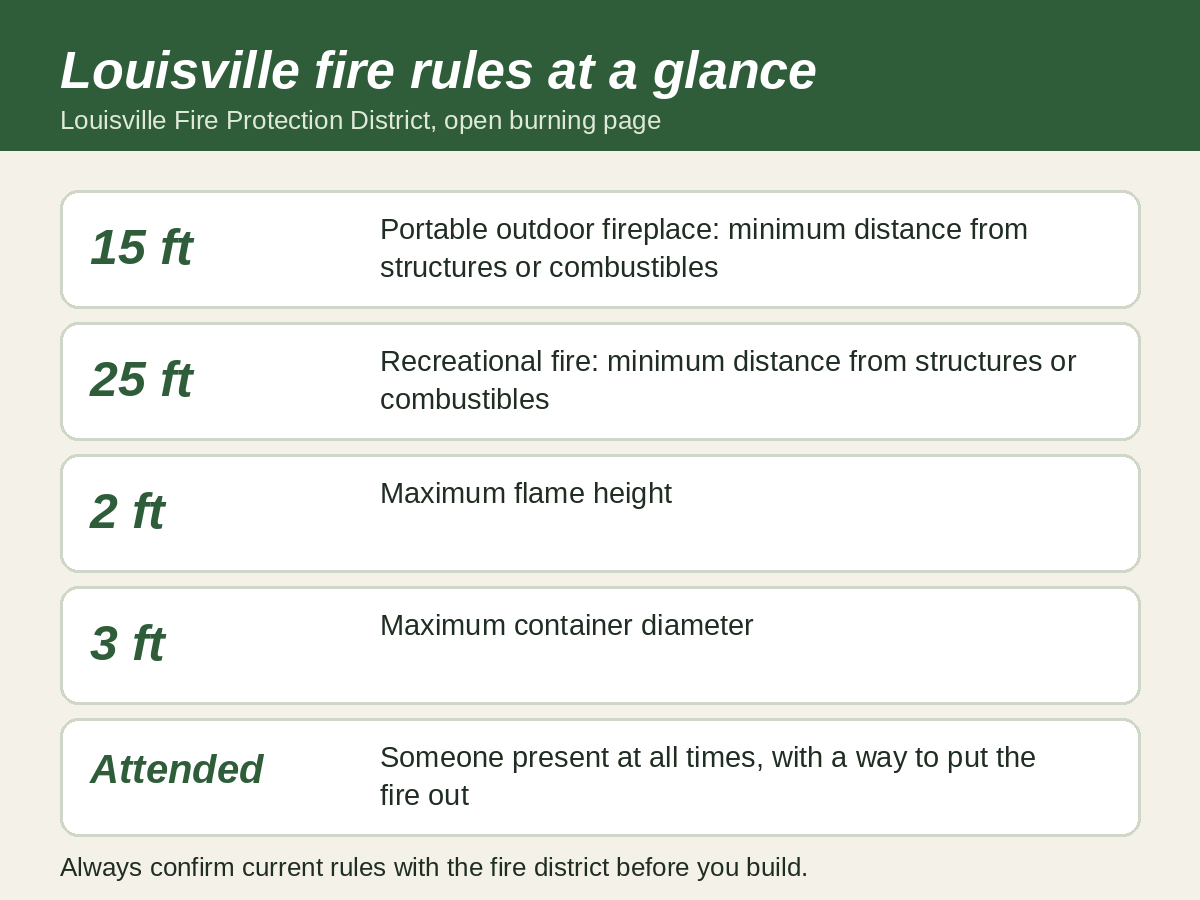
If the fire district responds and finds a fire unsafe, you must put it out right away. The page also asks residents to be considerate of neighbors about smoke.
One limit to know about: the district's page does not say whether gas and wood fires are treated differently, and it does not describe permanently built fire features. Those are exactly the questions to ask the district before you commit to a design. Rules and fire restrictions also change with conditions. Boulder County publishes its own restriction updates at boco.org/FireRestrictions, and the City of Louisville posts notices when restrictions are in effect.
Green Landscape Solutions says it helps homeowners navigate local regulations and permits as part of a project. Ask about your specific address at your first meeting.
Start with the spot, not the fire. A fire pit works best when it is planned alongside the patio, the seating, and the plants around it, rather than dropped in at the end. Colorado adds its own demands: freeze-thaw cycles, alkaline soils, and strong sun.
Green Landscape Solutions describes its fire pits as built with fire-rated stone, proper mortar, and components sized for those conditions. The design questions that matter most are these:
The photo at the top shows the idea in a modern mountain setting: a low round fire bowl with river stones, set on large-format pavers, with chairs angled toward the flame and purple-flowering perennials planted along the wall. The photo does not tell us what fuel the bowl burns.
Pick a level spot with room on every side. A pit near the edge of a patio, with seating that wraps around it, is easier to manage than one in the middle of a walkway.
Fire pits stretch the outdoor season into the cold months. For more on that idea, read how to extend your outdoor living season in Colorado.
A fire pit touches design, masonry, gas or fuel supply, and the patio around it. When one team handles all of it, there is one set of drawings and one group accountable for the result. Green Landscape Solutions works as a single design-build team in Boulder County, and it has done so since 2002.
Its stated process has three parts. A designer listens to your ideas and budget and proposes a design. The same company builds it, with a construction manager overseeing each stage from foundation prep to final installation. After the build, a designer or project manager walks the finished space with you and resolves any open items.
The firm lists wood-burning and gas options on its custom fire pit installation page. Fire features often pair with seating walls, patios, and pergolas, which are covered under outdoor living and entertaining. Learn more about the model on the design-build service page. Financing is available through HFS Financial, described on the financing page.
Green Landscape Solutions has served Boulder County since 2002 and has completed more than 1,000 projects. See the Louisville landscape design page for local details. The team also works in Lafayette, Superior, Erie, and Broomfield. Boulder homeowners can start from the service areas page.
Thinking about a fire pit this fall or next season? Call (720) 468-0987 or Tell Us About Your Property. We will talk through gas or wood, your layout, and what your fire district requires.
Wood gives you real crackle, embers, and smell, but you have to buy, store, and tend the fuel and manage smoke. Gas starts and stops with a switch and produces less smoke, but needs a gas line or propane supply planned into the design. The EPA says switching to natural gas or propane reduces harmful air pollutants.
Louisville Fire Protection District says no fire ban can be in effect, the fire must be in a container approved for fire use, and it must be attended with a way to put it out. Portable outdoor fireplaces need 15 feet of clearance and recreational fires need 25 feet. Flames can be no higher than 2 feet and the container no wider than 3 feet.
Louisville Fire Protection District prohibits burning trash, leaves, and other yard debris. The EPA also says never to burn green wood, construction waste, plastic, or garbage, and to avoid burning wood on air quality alert days.
Yes. The firm's fire pit page lists both wood-burning and gas options, designed alongside the patio, seating, and surrounding landscape. One design-build team handles the design and the construction.
Your fire district is the authority. For Louisville, that is Louisville Fire Protection District. Green Landscape Solutions says it helps homeowners navigate local regulations and permits, so ask about your specific address during your first meeting.
