


Four checks tell you when a dry Colorado winter day calls for the hose. Green Landscape Solutions, serving Longmont and Boulder County, explains what to water first, how lawns fit in, and how to drain the hose after, based on CSU Extension, PlantTalk Colorado, Plant Select, and Denver Water.


Lorem ipsum dolor sit amet, consectetur adipiscing elit. Suspendisse varius enim in eros elementum tristique. Duis cursus, mi quis viverra ornare, eros dolor interdum nulla, ut commodo diam libero vitae erat. Aenean faucibus nibh et justo cursus id rutrum lorem imperdiet. Nunc ut sem vitae risus tristique posuere.
Green Landscape Solutions, a design-build team serving Boulder County since 2002, hears the same question every November. A homeowner in Longmont has blown out the sprinklers, the leaves are down, and the yard looks done. Does anything still need water? Sometimes, yes. This guide gives a simple way to decide, one day at a time, and it sticks to what CSU Extension, PlantTalk Colorado, Plant Select, and Denver Water say.
We already covered why fall moisture matters and how much trees and shrubs need in Watering in the Fall: Why Colorado Landscapes Need It Most. This post is the winter follow-up. It covers the daily decision, lawns, and the hose work.
Check four things. Air temperature should be above 40 degrees F. There should be no snow cover. The soil should not be frozen. And the yard should be in an extended dry spell. If all four are true, water. If any one fails, wait for a better day.
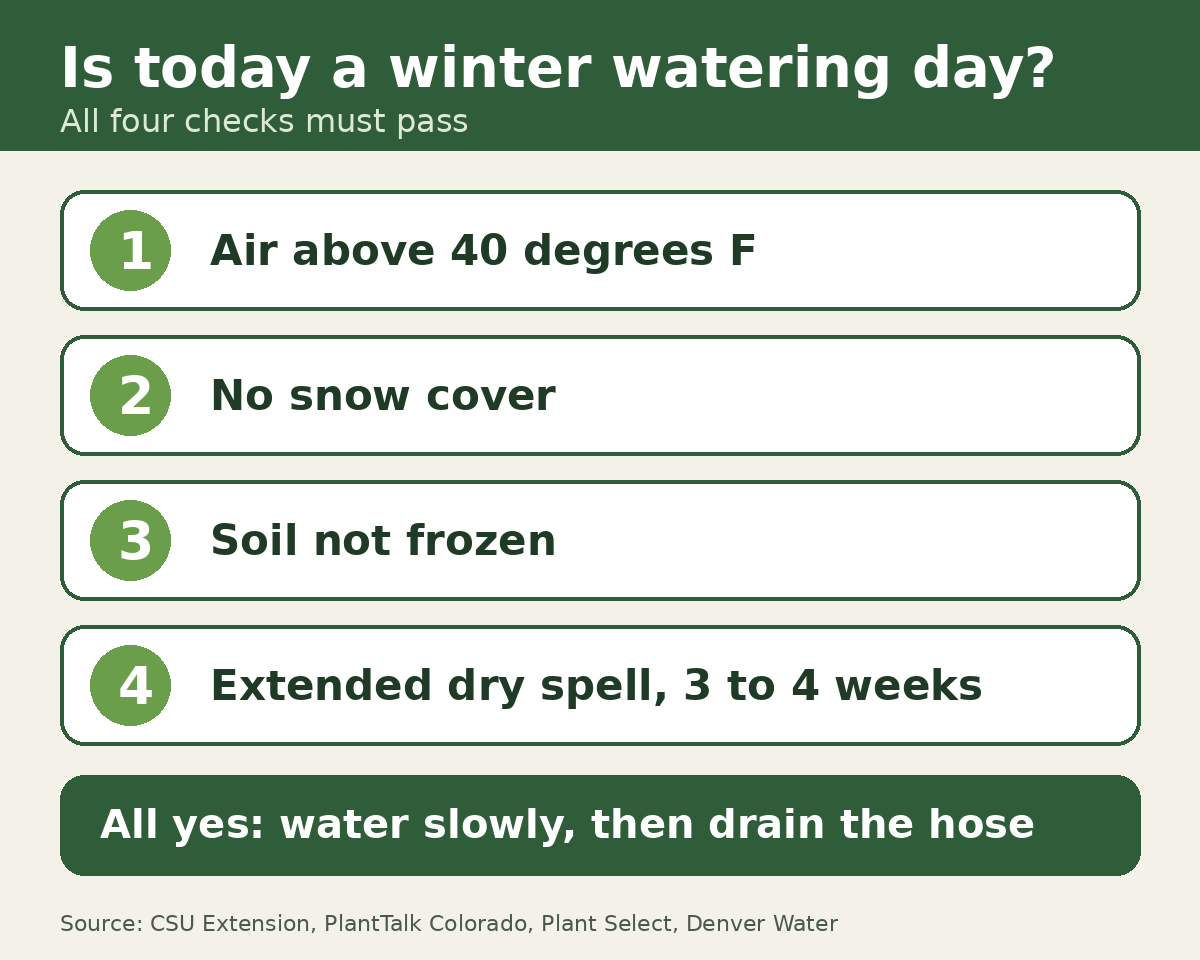
CSU Extension's Fact Sheet 7.211 says to water only when air temperatures are above 40 degrees F, with no snow cover. Plant Select adds ideally unfrozen ground, and Denver Water says to make sure the ground is not frozen. PlantTalk Colorado says the same about frozen soil.
The sources use slightly different markers, so treat them as a range. CSU Extension says to water during extended dry periods without snow cover, about once or twice a month. PlantTalk Colorado says to water again if four weeks pass without snow cover. Denver Water points to three to four weeks without measurable moisture.
A simple habit covers all three: mark the date of the last real snow or rain on the calendar. If it has been three to four weeks and the day is mild, it is time to check the soil.
Water on a mild day, early enough that the moisture soaks in before the night freeze. CSU Extension and Plant Select say midday. PlantTalk Colorado says early in the day. In practice, a late-morning session on a warm afternoon fits both.
The goal in every source is the same: give the water time to soak in before temperatures drop at night.
New plantings come first, then evergreens, then anything on a south or west exposure. CSU Extension says newly planted trees are the most susceptible to winter drought injury. It also says most evergreens benefit from winter watering, along with shallow-rooted trees such as birches, lindens, and several maples.
Plant Select adds shrubs planted in the last year and perennials planted in fall or bare-root plants set in the last year. It also lists plants in windy spots and plants in reflected heat from walls.
Plant Select says established xeric plants do not need regular irrigation in winter. Denver Water's article, quoting a CSU Extension expert, says water-wise and native plants can still benefit from an occasional drink in an unusually dry winter, or if they went in within the last year or two.
The two statements fit together. A mature, established bed of drought-adapted plants is the lowest priority. A xeric bed planted this past spring is not.
CSU Extension's rule of thumb is 10 gallons per inch of trunk diameter, measured 6 inches above the ground. A two-inch tree gets 20 gallons. Newly planted shrubs get 5 gallons twice a month. Established shrubs under 3 feet get 5 gallons monthly, and those over 6 feet get 18 gallons monthly. Reduce the amounts to account for precipitation.
Apply water under the dripline, so it soaks about 12 inches deep. Plant Select suggests timing how long a 5-gallon bucket takes to fill, so you know how long to leave the hose running.
Sometimes. A mature lawn in a normal winter often does not need help. A newly seeded or sodded lawn does, along with lawns facing south or west and lawns on windy sites. CSU Extension says water is the best way to prevent winter turf injury.
Denver Water says watering Kentucky bluegrass is not always necessary. A once-a-month soak during a long dry spell can help spring green-up. It suggests running a hose-end sprinkler until about half an inch of water collects in plastic cups set on the lawn.
The winter sun sits low, and walls, fences, and pavement reflect heat onto nearby turf. CSU Extension notes that this effect is stronger on south and west exposures. It also says lawns in warm exposures are prone to late winter mite damage, and that water helps prevent that injury.
CSU Extension also warns about the opposite problem. A solid layer of ice that stays on a lawn for more than a month can suffocate grass or leave it matted. Do not add water on top of ice.
Use a hose, a soaker hose, a soft spray wand, or a five-gallon bucket, and keep the in-ground system shut down. PlantTalk Colorado and Denver Water both say not to run the sprinkler system in winter. Plant Select, PlantTalk, and Denver Water all say to disconnect and drain the hose when you finish.
That last step matters. Denver Water says disconnecting the hose prevents freezing and pipe damage. For the timing of the shutdown itself, see When to Winterize Sprinklers in Colorado.
Winter watering protects roots through a dry season. It does not fix poor drainage, replace plants that were wrong for the spot, or rescue a bed that struggles every year. Damage from a dry winter can also stay hidden. CSU Extension says affected plants may look normal in spring, then weaken or die in late spring or summer.
If the same bed fails year after year, the cause may be the design. Landscape maintenance keeps a yard on track through the year. Water-wise planting and garden design can reduce how much a landscape depends on winter hose work in the first place. Green Landscape Solutions works on both for Boulder County properties. If a Longmont yard needs a plan before spring, start with our Longmont page.
Green Landscape Solutions serves yards across the Front Range. See our location pages for Longmont, Gunbarrel, Niwot, Lafayette, and Broomfield. You can also see our landscape maintenance service and the full service area, including Boulder.
Want a yard that handles winter without hose work every few weeks? Call (720) 468-0987 or Tell Us About Your Property.
Check four things. Air temperature should be above 40 degrees F, there should be no snow cover, the soil should not be frozen, and the yard should be in an extended dry spell of about three to four weeks. If all four are true, water slowly under the dripline.
Water on a mild day, early enough that the moisture soaks in before the night freeze. CSU Extension and Plant Select say midday. PlantTalk Colorado says early in the day. A late-morning session on a warm afternoon fits both.
Sometimes. New seeded or sodded lawns, lawns facing south or west, and lawns on windy sites are most at risk, according to CSU Extension. Denver Water says watering Kentucky bluegrass is not always necessary, but a once-a-month soak in a long dry spell can help spring green-up.
No. PlantTalk Colorado and Denver Water both say not to run the sprinkler system in winter. Water by hand with a hose, soaker hose, spray wand, or bucket, then disconnect and drain the hose when you finish.
Usually not. Plant Select says established xeric plants do not need regular winter irrigation. Denver Water, quoting a CSU Extension expert, says water-wise and native plants can still benefit from an occasional drink in an unusually dry winter or if planted in the last year or two.
