
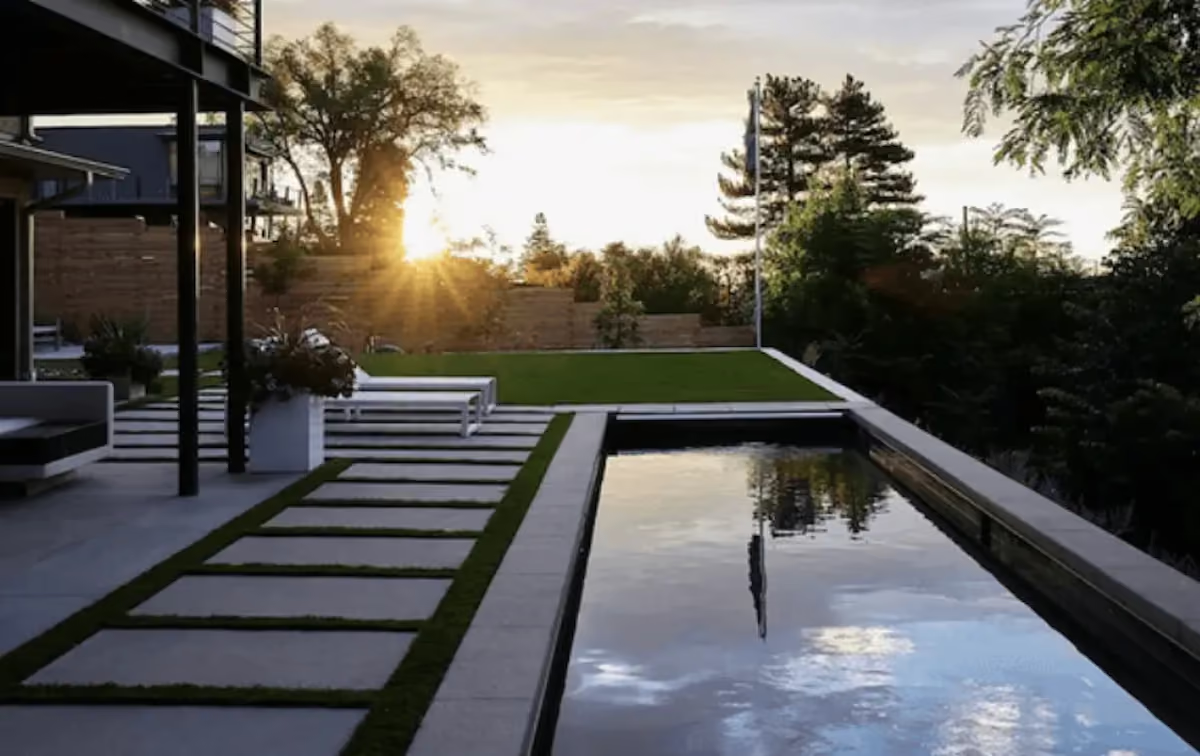

Water costs are rising, regulations are tightening, and Boulder just overhauled its landscaping code. Here's an honest comparison of xeriscaping vs. traditional landscaping for Front Range homeowners.


Lorem ipsum dolor sit amet, consectetur adipiscing elit. Suspendisse varius enim in eros elementum tristique. Duis cursus, mi quis viverra ornare, eros dolor interdum nulla, ut commodo diam libero vitae erat. Aenean faucibus nibh et justo cursus id rutrum lorem imperdiet. Nunc ut sem vitae risus tristique posuere.
Ten years ago, this was a question with a clear answer for most Boulder County homeowners: keep the lawn, add some flower beds, and water on schedule.
Today, the answer is more complicated. Water costs are rising. State laws are changing. The City of Boulder just overhauled its landscaping code for the first time in over 20 years. And the climate is pushing the Front Range toward landscapes that work with Colorado's semi-arid conditions rather than against them.
But xeriscaping isn't automatically the right choice for every property, and traditional landscaping isn't obsolete. The real question isn't "which is better" but "which combination makes the most sense for how you use your outdoor space." Here's the honest comparison.
First, some definitions worth clearing up.
Traditional landscaping in Boulder County typically means bluegrass or fescue lawns, irrigated flower beds, ornamental shrubs, and shade trees. It requires regular mowing, seasonal fertilization, aeration, and consistent irrigation from April through October. A well-maintained traditional landscape looks lush and green, provides a play surface for kids and pets, and is what most neighborhoods in Boulder County were designed around.
Xeriscaping is a landscape design approach built around water conservation. The term was coined by Denver Water in 1981 (from the Greek word "xeros," meaning dry). Xeriscaping does not mean covering your yard in gravel and calling it done. A well-designed xeriscape uses drought-tolerant and native plants, efficient drip irrigation, organic mulch, and strategic zones that match water use to how you actually use each area of your property. It can be just as colorful and visually rich as a traditional landscape.
The biggest misconception is that you have to choose one or the other. Most of the landscapes we design at Green Landscape Solutions fall somewhere in between, blending functional turf areas with water-wise planting beds, native ground covers, and efficient irrigation. That hybrid approach is increasingly the standard along the Front Range.
The numbers make the case for rethinking traditional turf. According to Colorado State University, outdoor water use accounts for roughly 55% of residential water use in urban areas along the Front Range, and most of that water goes to turf grass. Colorado WaterWise's YARDX study, which tracked actual homeowner yards on the Front Range, found that xeriscape designs reduced water use by 18% to over 50% compared to traditional turf landscapes.
One Lafayette homeowner and irrigation professional documented his own front yard conversion in detail: his xeriscape used just 10% of the water his lawn had required, saving over 21,000 gallons in the first year.
Boulder County's water situation is tightening from multiple directions.
Boulder's new landscaping rules. In January 2026, Boulder City Council approved the city's first major landscaping overhaul in two decades. The new rules prohibit daytime watering (10 a.m. to 6 p.m.) from May 1 through September 30, ban new juniper plantings citywide, and bring Boulder into compliance with new state standards. Low-volume drip and subsurface irrigation are exempt from the watering window restrictions, giving xeriscape and drip-irrigated landscapes a practical advantage.
Colorado's nonfunctional turf ban. Senate Bill 24-005, signed by Governor Polis in 2024, prohibits the installation of nonfunctional turf, artificial turf, and invasive plants on commercial, institutional, industrial, and common interest community properties for new development and redevelopment projects as of January 1, 2026. Residential properties are currently exempt (except HOA common areas), but the regulatory direction is clear: the state is moving away from water-intensive turf.
HOA restrictions are loosening. Senate Bill 23-178 prevents HOAs from prohibiting drought-tolerant landscaping and requires them to provide homeowners with at least three approved water-wise garden designs. If your HOA has been the barrier to xeriscaping, that barrier is now significantly lower.
Lafayette's permanent water restrictions. Since 2013, Lafayette has maintained year-round restrictions limiting outdoor irrigation to three days per week with no watering between 10 a.m. and 6 p.m. Similar restrictions exist across Boulder County municipalities.
This is where the conversation gets practical.
Upfront installation costs. A full xeriscape installation typically costs more per square foot than laying sod and planting a traditional landscape. Xeriscape involves more design complexity, soil amendment, drip irrigation installation, mulch, and a wider variety of plant material.
However, the gap narrows significantly on larger properties and in situations where the traditional alternative would require extensive irrigation infrastructure, amended soil, and ongoing establishment watering.
Long-term maintenance costs. This is where xeriscaping wins decisively. Colorado WaterWise estimates that switching from traditional turf to xeriscape can reduce maintenance costs by up to 60%. Traditional lawns in Boulder County require weekly mowing (roughly 26 to 28 weeks per year), seasonal aeration, two to three fertilizer applications annually, ongoing weed control, and regular irrigation system maintenance. A mature xeriscape needs periodic weeding, annual mulch refresh, occasional pruning, and minimal irrigation adjustment.
Water costs. Boulder County water rates are tiered, meaning the more you use, the more you pay per gallon. Outdoor irrigation during summer can push households into the highest pricing tiers. Reducing irrigation demand through xeriscaping drops your usage into lower tiers where every gallon costs less. The savings compound as water rates continue to rise, which they do nearly every year along the Front Range.
Property value. Colorado WaterWise reports that a well-designed xeriscape can increase property value by as much as 15%. The key phrase is "well-designed." A professionally installed xeriscape with diverse plantings, clean hardscape, and thoughtful layout adds value. A yard that looks like someone dumped gravel and walked away does the opposite.
Available rebates. Multiple water districts and municipalities along the Front Range offer turf replacement rebates. Programs vary by location and change frequently, so check with your specific water provider. The state's HB 22-1151 also provides grant funding for turf replacement through local governments and water districts.
Traditional turf isn't going away entirely, nor should it. There are legitimate reasons to keep lawn in your landscape.
Active-use areas. If you have kids, dogs, or regularly use your yard for sports, play, or entertaining on the ground, turf is still the best surface. No ground cover or mulch bed serves the same purpose. The key is sizing the lawn to what you actually use. A 300-square-foot play area makes sense. A 3,000-square-foot lawn that nobody walks on does not.
Cooling effect. Turf is measurably cooler than rock, gravel, or hardscape surfaces. The City of Boulder's landscaping code specifically notes that rock mulch increases the urban heat island effect. In areas where you spend time outdoors during summer, grass or plant coverage keeps temperatures more comfortable than hard surfaces.
Established landscapes with mature trees. Many older Boulder County properties have mature trees that have been receiving irrigation water from the surrounding lawn for decades. Removing that lawn without adjusting the trees' water supply can lead to stress, decline, and potentially the loss of irreplaceable shade canopy. Any lawn-to-xeriscape conversion on a property with mature trees needs a plan that continues watering those trees.
HOA and neighborhood expectations. Even with the new state laws loosening HOA restrictions, some neighborhoods maintain strong aesthetic standards. A professionally designed xeriscape can absolutely meet those standards, but it requires more upfront design investment than standard sodding.
For many Boulder County properties, the advantages of xeriscaping are overwhelming.
New construction. If you're starting from bare dirt, designing a water-wise landscape from the beginning is far more cost-effective than converting later. You avoid the double expense of installing traditional irrigation and then retrofitting it. Many new developments are already moving toward water-wise landscape standards.
Front yards and streetside areas. Most front yards are purely decorative. They're rarely used for recreation and exist primarily for curb appeal. Converting a front yard from bluegrass to a designed xeriscape with native plants, decorative stone, and seasonal color eliminates the highest-maintenance, highest-water-use area of most properties.
Slopes and hard-to-irrigate areas. Any area where sprinkler water runs off before it soaks in is a candidate for xeriscape. Slopes, narrow strips between sidewalk and street, corners, and areas far from the house tend to get overwatered or underwatered in traditional spray irrigation systems. Drip-irrigated native plantings solve both problems.
Second homes, rental properties, and low-use landscapes. If you're not home to monitor irrigation, mow weekly, and manage a lawn, xeriscape reduces the demand on your time and your property manager's time. A mature xeriscape is far more forgiving of missed maintenance than a traditional lawn.
Properties in the foothills. Higher elevations, more wind, thinner soils, and closer proximity to wildfire risk all favor xeriscaping. The City of Boulder's new rules specifically address fire-wise landscaping alongside water-wise goals, banning junipers (highly flammable) from new plantings citywide.
The landscapes that perform best in Boulder County combine elements of both approaches. This is the strategy we use on most residential projects at Green Landscape Solutions.
Zone your property by use. Keep functional turf where you actually need it: a play area, a patio-adjacent lounging lawn, a space for entertaining. Convert everything else to water-wise plantings, mulched beds, native ground covers, or hardscape.
Design for four-season interest. One common criticism of xeriscaping is that it looks good in summer but bare in winter. A well-designed xeriscape includes evergreen structure (dwarf conifers, ornamental grasses left standing through winter), plants with interesting bark or seed heads, and enough architectural hardscape to carry the design year-round.
Use the seven principles of xeriscaping as a framework. Planning and design, soil analysis, efficient irrigation, appropriate plant selection, mulching, limited turf, and proper maintenance. These principles don't require eliminating turf entirely. They require being intentional about where and how you use water.
Invest in drip irrigation. Boulder's new rules exempt low-volume drip and subsurface irrigation from the daytime watering ban. Drip systems deliver water directly to plant roots, reducing waste from evaporation and overspray by 30% to 50% compared to traditional spray heads. For xeriscape zones, drip is the standard.
Choose plants adapted to Boulder County. The best xeriscape plants for our area include native and adapted species that thrive in USDA Zone 5b/6a, alkaline clay soil, intense UV, and 12 to 18 inches of annual precipitation, etc.
The regulatory landscape in Colorado is shifting fast. Here's where things stand as of early 2026.
If you're a residential homeowner: The state's nonfunctional turf ban does not currently apply to single-family residential properties. You can still plant bluegrass. But water restrictions, rising water costs, and the direction of municipal codes all favor reducing turf over time.
If you're in an HOA: Your HOA cannot prevent you from installing drought-tolerant landscaping, per SB 23-178. They must offer at least three approved water-wise designs. Common interest community properties (HOA common areas) are subject to the nonfunctional turf ban for new development as of January 2026.
If you're building or renovating in Boulder: The city's new landscaping rules (effective March 2026) apply to new construction and major renovations that trigger building permits. Daytime watering is banned May through September. No new junipers. If your project requires a landscape plan, water-wise design is essentially mandatory.
If you're a commercial property owner: The nonfunctional turf ban applies to your property for any new development or redevelopment. Plan accordingly with your landscape architect.
The right answer depends on three things: how you use your outdoor space, how much time and money you want to spend maintaining it, and how you want your property to look five and ten years from now.
A Green Landscape Solutions consultation starts with those questions. Our landscape architects and designers create landscapes that balance beauty, function, and water efficiency. Whether that means a full xeriscape conversion, a hybrid approach with strategic turf areas, or a traditional landscape with smart irrigation, the design is tailored to your property, your budget, and how you live outdoors.
Contact us at (720) 468-0987 or visit greenlandscapellc.com to schedule a consultation.
Green Landscape Solutions is a premier landscape architecture, maintenance, and construction firm serving Boulder, Erie, Lafayette, Louisville, Niwot, Superior, Broomfield, Thornton, and many others since 2002. We specialize in sustainable, water-wise landscape design built for Colorado's unique climate.
