
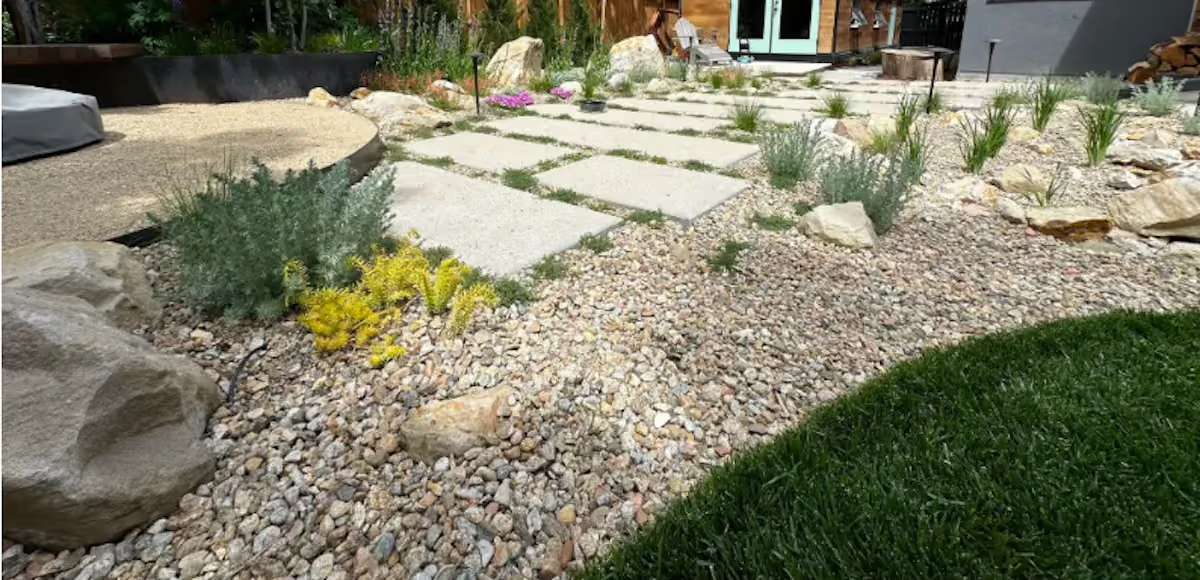

Boulder just rewrote its landscaping rulebook for the first time in over 20 years — and if you're planning any work on your property this year, the new rules are already in effect. On January 8, 2026, Boulder City Council unanimously approved Ordinance 8721, a sweeping update to the city's landscaping standards built around three priorities: water conservation, wildfire resilience, and urban cooling. The changes took effect March 7, 2026. Here's what Boulder homeowners actually need to know.


Lorem ipsum dolor sit amet, consectetur adipiscing elit. Suspendisse varius enim in eros elementum tristique. Duis cursus, mi quis viverra ornare, eros dolor interdum nulla, ut commodo diam libero vitae erat. Aenean faucibus nibh et justo cursus id rutrum lorem imperdiet. Nunc ut sem vitae risus tristique posuere.
Boulder just rewrote its landscaping rulebook for the first time in over 20 years. On January 8, 2026, City Council voted unanimously to approve Ordinance 8721, a sweeping update to the city's landscaping standards focused on water conservation, wildfire resilience, and urban cooling. The new rules take effect March 7, 2026.
Whether you're planning a landscape renovation, building a new home, or just trying to understand how this affects your property, here are the five biggest changes and what they actually mean for Boulder homeowners.
This is the change getting the most attention. As of August 2025, no new junipers can be planted anywhere within Boulder city limits. If you're doing new construction or a major redevelopment, existing junipers on the property must be removed as part of the project.
Why junipers? They're among the most flammable landscape plants in Colorado. During the Marshall Fire, wind-driven embers ignited vegetation near homes, and junipers, packed with volatile oils, burn fast and hot. The city is eliminating them from future landscapes to reduce wildfire fuel loads across Boulder neighborhoods.
What this means for you: If you already have junipers, you don't have to rip them out tomorrow. The ban applies to new plantings and redevelopment projects, not existing landscapes. But if you're planning any landscape work that requires a permit, junipers won't be on the approved list.
What to plant instead: Several native and adapted shrubs provide similar structure and year-round green without the fire risk. Consider native options like three-leaf sumac, mountain mahogany, or wax currant. For evergreen screening, consider Austrian pine or Colorado blue spruce as tree alternatives, or switch to low-growing kinnikinnick for groundcover where junipers once sprawled.
Boulder's new code aligns with Colorado Senate Bill 24-005, which took effect January 1, 2026. High-water-demand grasses like Kentucky bluegrass can now only be used in "functional turf" areas, meaning places where people actively use the grass, such as playgrounds, sports fields, and parks.
That means no more bluegrass in commercial medians, along transportation corridors, or as decorative turf that nobody walks on.
What this means for you: Residential lawns are not directly banned under this ordinance. But the signal is clear: Boulder is moving away from water-intensive turf. If you're installing new sod as part of a permitted project, you'll likely need to choose a low-water variety or limit bluegrass to areas with a functional purpose.
Practical alternatives that work in Boulder:
From May 1 through September 30, watering your landscape between 10 a.m. and 6 p.m. is now prohibited. The reason is simple: watering during the hottest part of the day wastes water through evaporation and wind drift.
The exception: Low-volume drip irrigation and subsurface irrigation systems can run at any time since they deliver water directly to root zones with minimal evaporative loss.
What this means for you: If you're still running spray sprinklers on a midday timer, it's time to adjust your schedule. Early morning watering (before 10 a.m.) is the most efficient because temperatures are cool, winds are calm, and water has time to soak into the soil before the sun heats up.
Smart irrigation tips for the new rules:
All new plantings in permitted projects must now adhere to a city-maintained Approved Tree and Plant List. This list prioritizes native, low-water, and low-flammability species suited to Boulder's climate. The city is moving technical planting standards out of the land use code and into a new Landscaping Manual, which will make it easier to update the approved list as conditions and knowledge evolve.
What this means for you: If you're submitting a landscape plan for a new build, remodel, or commercial project, your plant selections need to come from this list. Existing plants that aren't on the approved list won't need to be removed, but they'll need to be maintained (trimmed) to comply with code.
The approved list emphasizes plants that check three boxes: low water demand, low flammability, and ecological value for pollinators and wildlife. This is good news for homeowners who want landscapes that look great, survive Colorado's dry summers, handle freeze-thaw cycles, and support local ecosystems.
Where to find the list: The city is finalizing the approved tree and plant list through the Be Heard Boulder Waterwise Landscaping Project page. You can also consult the CSU Extension's native plant guides for Front Range recommendations, or Resource Central's Garden In A Box program for pre-designed waterwise garden kits.
One of the most significant structural changes is how Boulder will manage its landscaping standards going forward. Instead of embedding detailed planting, mulch, soil, and irrigation requirements in the land use code (which requires a formal ordinance process to update), those technical standards are moving into a new Landscaping Manual maintained by city staff. This allows the city to update plant recommendations, irrigation requirements, and best practices more quickly as climate conditions and horticultural knowledge evolve.
What this means for you: The rules governing what you can plant, how you irrigate, and what materials you use will be easier for the city to keep current. For homeowners and property managers, this means the standards you're designing around today are more likely to reflect the latest science and local conditions rather than requirements written years ago.
Why professional design matters more now, not less: With a new approved plant list, updated irrigation standards, wildfire resilience requirements, and shifting turf restrictions, navigating the landscaping code has become more complex. Working with a credentialed landscape architect who understands these regulations, along with Boulder's specific soil conditions, microclimates, and drainage challenges, helps ensure your project meets code from day one and avoids costly revisions.
Other notable updates from the final ordinance: The early draft included a ban on weed fabric, which was removed based on community feedback. However, the city still recommends against weed fabric based on guidance from the Denver Botanic Gardens, CSU Extension, and the Colorado Native Plant Society. Their reasoning: weed fabric encourages aggressive weeds, restricts desired plant growth, reduces rainwater infiltration, and actually increases fire risk due to flammability of the fabric itself.
It's worth noting what the ordinance doesn't do:
The ordinance primarily affects new construction, major remodels, commercial properties, and any project that requires a landscaping permit. For most existing homeowners, the daytime watering restriction is the most immediately relevant change.
Boulder's landscaping code hadn't been significantly updated since 2003. In that time, the city has experienced the Marshall Fire, ongoing drought conditions, and mounting pressure on water resources. The community has voluntarily reduced water use by 30% over the past two decades, and these new rules build on that momentum.
The ordinance also aligns Boulder with statewide trends. Colorado Senate Bill 24-005 prohibits nonfunctional turf, artificial turf, and invasive species on commercial and institutional properties statewide as of January 2026. Boulder's code goes a step further by incorporating wildfire resilience into the same framework.
For homeowners considering a landscape renovation, this is actually an opportunity. Water-wise landscapes designed with native plants, efficient irrigation, and fire-resistant materials tend to cost less to maintain over time, look better through all four seasons, and align with where the market is heading. Properties with sustainable landscaping are increasingly valued by buyers along the Front Range.
With over 20 years of experience designing and building landscapes in Boulder County, our team works with these exact conditions every day: clay soils, freeze-thaw cycles, semi-arid climate, and now the updated city code.
Whether you're planning a full landscape renovation, converting thirsty turf to a water-wise design, or replacing junipers with fire-resistant alternatives, we handle the entire process from design through construction.
Ready to get started? Contact us at (720) 468-0987 or visit greenlandscapellc.com to schedule a consultation.
Do I have to remove my existing junipers? No. The juniper ban applies to new plantings only. Existing junipers on your property can stay. However, if you undertake a new development or redevelopment project, junipers will need to be removed as part of that work.
Can I still have a lawn? Yes. The ordinance restricts high-water grasses like Kentucky bluegrass to functional turf areas in commercial and permitted projects. Existing residential lawns are not banned. However, if you're installing new turf as part of a permitted project, you may need to choose a low-water grass variety.
When does the daytime watering ban start? The restriction runs May 1 through September 30 each year, prohibiting irrigation between 10 a.m. and 6 p.m. Drip and subsurface irrigation systems are exempt.
Where can I find the approved plant list? The city is developing the final list through the Waterwise Landscaping Project on Be Heard Boulder. You can also consult CSU Extension's native plant resources or contact a local landscape professional for guidance.
Does this affect my HOA? The state law (SB 24-005) applies to common interest communities, prohibiting nonfunctional turf, artificial turf, and invasive species in new projects. If your HOA is planning landscape updates, the new rules will apply.
Green Landscape Solutions is a premier landscape architecture and construction firm serving Boulder, Lafayette, Louisville, Erie, Superior, and Broomfield since 2002. We specialize in sustainable, water-wise landscape design built for Colorado's unique climate.
