

Winter sunsets in Boulder come as early as 4:35 p.m. Here is how to light a Superior backyard for dark evenings without glare, using Boulder County rules and DarkSky principles.


Lorem ipsum dolor sit amet, consectetur adipiscing elit. Suspendisse varius enim in eros elementum tristique. Duis cursus, mi quis viverra ornare, eros dolor interdum nulla, ut commodo diam libero vitae erat. Aenean faucibus nibh et justo cursus id rutrum lorem imperdiet. Nunc ut sem vitae risus tristique posuere.
Aim light down, shield the source, keep levels low, and light surfaces instead of eyes. Put fixtures where they wash a wall, step, or path, not where they shine at the seating area. Choose warm bulbs and add a timer.
Green Landscape Solutions designs and installs landscape lighting for homes across Boulder County, including Superior. The firm says good lighting depends on placement rather than brightness. That matches what DarkSky International teaches. Its first two principles are that light should have a clear purpose and be directed only where it is needed.
Winter gives you more dark hours to light. NOAA's Boulder table lists sunset at 4:35 p.m. standard time from December 5 through 10. That is the earliest of the year. Your yard is in use after dinner, not just after work.
That shift changes the job. In July, a path light might run for an hour. In December it runs for hours, and you look at it from a warm kitchen window. A fixture that seemed fine in summer can read as harsh against dark snow and bare branches.
Wherever neighbors sit close, bright light crosses a fence line easily, and that includes many Superior yards. The same careful placement that cuts glare also keeps your light on your own property. You can see the Superior landscape design page for the area Green serves.
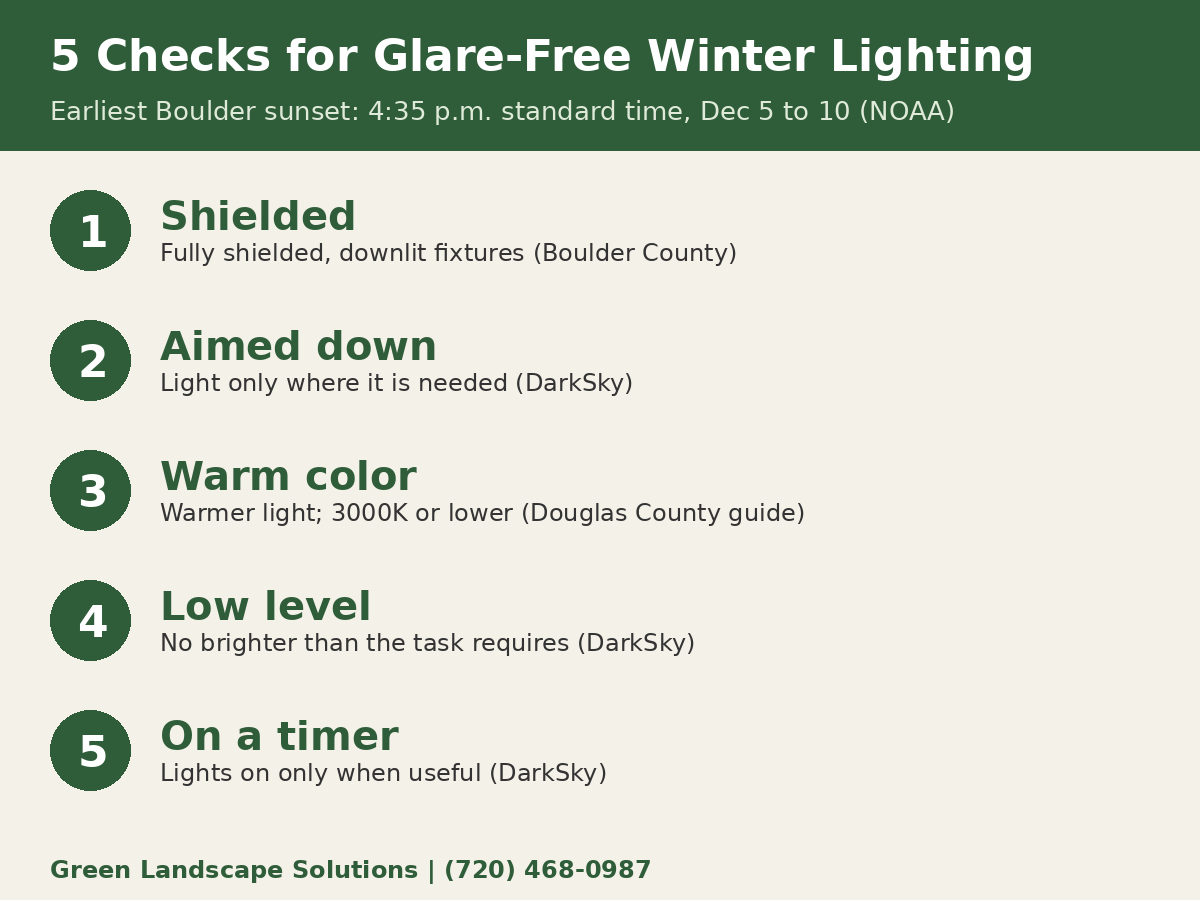
Glare is excessive brightness that makes it hard to see or uncomfortable to look at. In a yard it usually comes from three things: a bare bulb you can see from the seating area, a fixture aimed outward instead of down, or too much light for the task.
Douglas County's residential lighting guide defines glare this way and defines light trespass as light falling where it is "not intended, wanted, or needed." Both problems show up more in winter. Dark surroundings make any bright point feel brighter, and snow bounces light back up.
Boulder County's lighting publication says outdoor lights must be fully shielded and downlit, with an opaque shield. It also says lighting over 12 feet high is not permitted and blinking or color-changing lights are not allowed. New exterior fixtures, including landscape lighting, must be approved before a building permit is issued.
Those rules come from the county's Community Planning and Permitting publication, which points to Article 7-1600 of the Boulder County Land Use Code. The page does not say whether it covers only unincorporated areas. Superior, Louisville, Lafayette, and other towns may have their own codes. HOAs can add rules too.
The county page also notes that Dark-Sky-approved fixtures are not automatically compliant, so staff should be consulted. It says every installed fixture must be UL listed. The page lists no color temperature limit and does not address curfews. Confirm details with the county at 303-441-3930 or with your town before you buy.
Warm light at a low level works best. DarkSky International's fifth principle is to use warmer-colored light and limit blue-violet light. Douglas County's guide sets a ceiling of 3000K correlated color temperature for its HOA sample rules. Kelvin (K) is the number on the box that tells you how warm or cool a bulb looks.
The 3000K figure is one county's guideline for HOAs, not a Boulder County rule. It is still a handy target. Warm light also flatters stone, wood, and evergreen foliage, which carry a Colorado yard through winter.
DarkSky's third principle says illumination should be no higher than necessary. In practice, light the steps, the path edge, and one or two features. Leave the rest dark. Your eyes adjust, and the yard feels calmer.
Put path and step lights low and shielded, wall lights beside doors, and accent lights aimed at a feature from the side. Keep fixtures out of the main sight line from your patio seating. Douglas County's guide also caps fixture height at 10 feet above the walking surface for its sample rules.
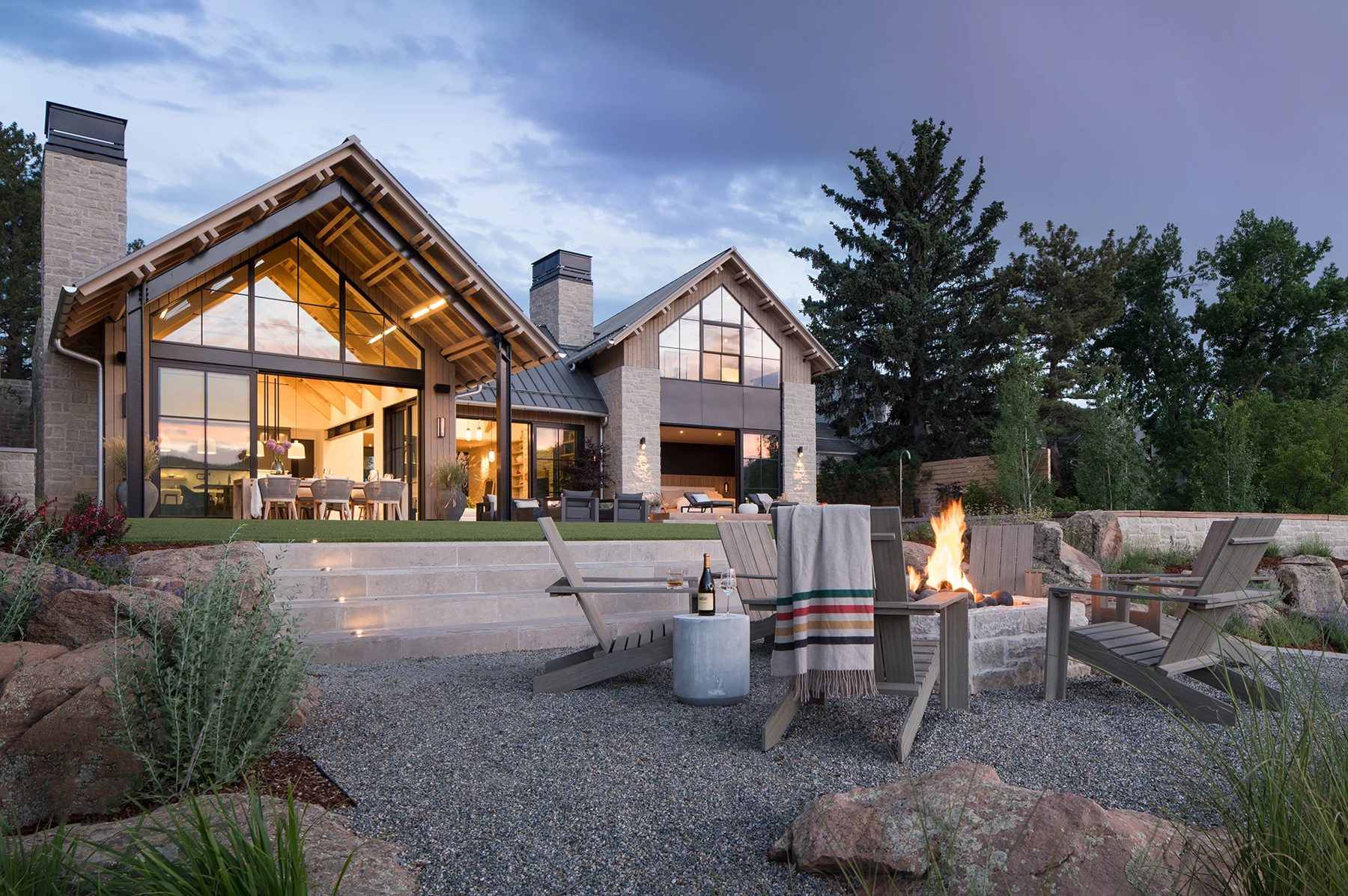
The photo at the top of this post shows several of these moves on a mountain-style home. Small recessed lights mark the edge of a wide stone stair. Wall-mounted fixtures near the doors wash the stone beside them. The fire pit seating sits on gravel, away from any bare bulb. The photo is a Green Landscape Solutions image, and we have not labeled the property.
For a look at a twilight patio, see our Steal This Look post on a mountain-modern pool terrace.
Timers and motion sensors turn lights off when nobody needs them. DarkSky's fourth principle says light should be used only when it is useful, with controls such as timers or motion detectors. A timer set to dusk-to-late-evening covers most winter routines without leaving the yard lit all night.
Douglas County's HOA sample rules go further for side and rear lights, calling for motion detectors with an on-time of no more than five minutes. That is a guideline for one county, and your needs may differ. The idea is worth borrowing for rarely used areas, like a side gate.
Lighting does not make a yard safe by itself. A path light shows an edge, but it will not fix a loose stone or an icy step. It also will not hide a poorly planned yard. The firm's page says lighting adds safety, depth, and a more inviting yard after dark, and the design underneath still matters most.
Lighting also adds an electrical component. Fixtures are electrical equipment, and Boulder County says each installed fixture must be UL listed. Ask your designer who handles approvals.
Green Landscape Solutions has served Boulder County since 2002 and lists more than 1,000 completed projects. The team designs and builds under one roof, from landscape lighting design and installation to patios and fire pits. See our pages for Superior, Louisville, Lafayette, Erie, and Niwot. Boulder homeowners can see the service areas page. Financing is available through HFS Financial on our financing page.
Follow DarkSky International's five principles: give every light a purpose, aim it where needed, keep the level low, control it with timers, and use warm color. Shielded fixtures aimed downward keep light on your property.
Boulder County says new exterior fixtures, including landscape lighting, must be approved before a building permit is issued. Your town may differ, so ask your town's building department and your HOA before you install.
DarkSky recommends warmer colors. Douglas County's HOA sample rules cap color temperature at 3000K. Boulder County's lighting publication does not list a Kelvin limit, so check your town and HOA.
NOAA's Boulder table shows sunset at 4:35 p.m. standard time from December 5 through 10, the earliest of the year. Dusk follows shortly after.
Yes. Unshielded fixtures and outward aim send light across property lines. Fully shielded, downward-aimed fixtures reduce that, and timers limit how long lights stay on.
A good lighting plan starts with how you use the yard after dark. Call (720) 468-0987 or Tell Us About Your Property, and the team will talk through placement, permits, and fixtures for your home.
Follow DarkSky International's five principles: give every light a purpose, aim it where needed, keep the level low, control it with timers, and use warm color. Shielded fixtures aimed downward keep light on your property.
Boulder County says new exterior fixtures, including landscape lighting, must be approved before a building permit is issued. Your town may differ, so ask your town's building department and your HOA before you install.
DarkSky recommends warmer colors. Douglas County's HOA sample rules cap color temperature at 3000K. Boulder County's lighting publication does not list a Kelvin limit, so check your town and HOA.
NOAA's Boulder table shows sunset at 4:35 p.m. standard time from December 5 through 10, the earliest of the year. Dusk follows shortly after.
Yes. Unshielded fixtures and outward aim send light across property lines. Fully shielded, downward-aimed fixtures reduce that, and timers limit how long lights stay on.
