
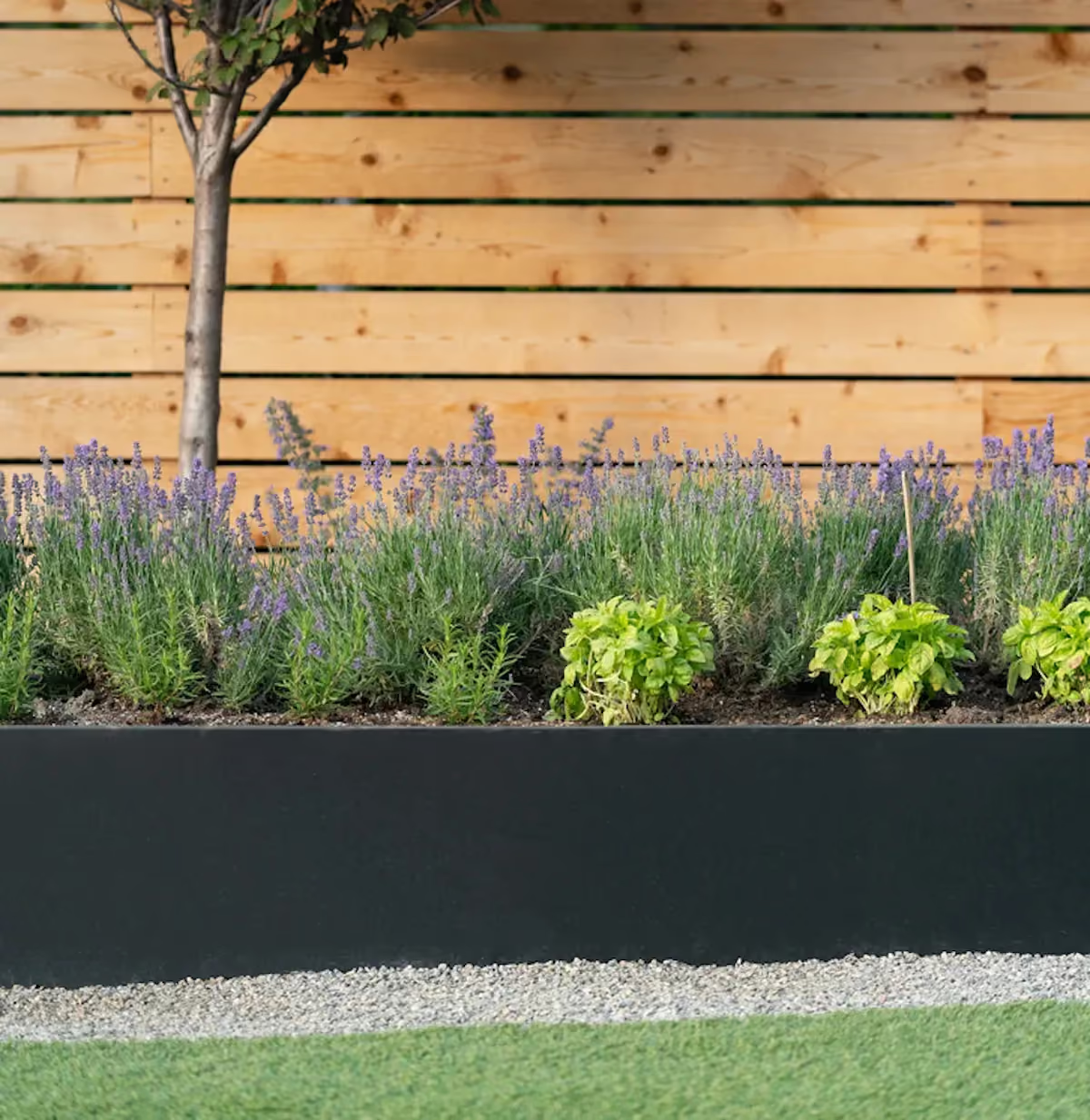

There's a particular kind of landscape that stops you mid-step. Not because it's packed with color or overflowing with plants, but because everything in it feels deliberate. The stone is placed with intention. The planting beds breathe. The edges are clean. And the space between elements does as much work as the elements themselves.


Lorem ipsum dolor sit amet, consectetur adipiscing elit. Suspendisse varius enim in eros elementum tristique. Duis cursus, mi quis viverra ornare, eros dolor interdum nulla, ut commodo diam libero vitae erat. Aenean faucibus nibh et justo cursus id rutrum lorem imperdiet. Nunc ut sem vitae risus tristique posuere.
There's a particular kind of landscape that stops you mid-step. Not because it's packed with color or overflowing with plants, but because everything in it feels deliberate. The stone is placed with intention. The planting beds breathe. The edges are clean. And the space between elements does as much work as the elements themselves.
That's minimalist landscape design. And Colorado might be the best place in the country to practice it.
The semi-arid light here is different from anywhere else. Shadows are sharp. Colors saturate under 300 days of sunshine. Stone reads with a clarity that overcast climates can't match. And the natural landscape surrounding Boulder County - the Flatirons, the foothills, the open grasslands - is itself a study in restraint: bold forms, muted palettes, and vast negative space. Minimalist design doesn't fight that context. It joins it.
Minimalist landscape design is not about having less. It's about having only what matters.
Every element serves a purpose, either functional or visual. There's no filler, no default planting, no "put something here because the space is empty." The lawn that exists is there because someone uses it, not because it was the easiest thing to install. The stone was chosen for its specific texture and color, not pulled from a bin at random. The plants were selected for their form, their movement, and their relationship to each other across the seasons.
This is a design discipline rooted in a few core ideas.
Restraint in palette. The most effective minimalist landscapes work with a limited material palette. One or two stone types. A focused plant list of five to ten species rather than thirty. A hardscape material that repeats across the patio, walkway, and walls rather than mixing three or four finishes. This restraint creates visual calm. The eye isn't bouncing between competing materials. Instead, it settles into the rhythm of the space.
Negative space as a design element. Open ground, whether it's a plane of gravel, a sweep of native grass, or a clean expanse of concrete, isn't wasted space. It's the canvas that makes focal elements stand out. A single specimen tree in a field of decomposed granite has more presence than that same tree surrounded by a dozen shrubs and three kinds of groundcover. In Colorado's landscape, where the sky is enormous and the mountains dominate the horizon, negative space in a residential property connects the designed space to the natural one.
Strong geometry. Clean lines, defined edges, and deliberate shapes give a minimalist landscape its structure. Rectangular planting beds. A patio with a precise edge where stone meets gravel. A linear water feature or a single row of ornamental grasses. Geometry provides the framework. Plants, stone, and light fill it in.
Materials over ornamentation. In a minimalist design, the beauty of the materials carries the aesthetic. The grain pattern of a flagstone slab, the weathered surface of a Cor-Ten steel planter, the texture of raked decomposed granite. These surfaces are the decoration. There's no need for ornamental accents when the materials themselves have visual presence.
Minimalist design principles originated in places like Japan and Scandinavia, but they translate remarkably well to the Front Range. The climate and landscape actively support the approach.
Less water, less lawn, more clarity. Colorado's semi-arid climate already pushes landscapes away from the water-intensive, plant-dense model that works in the Northeast or Pacific Northwest. Rather than fighting the climate to maintain a high-input landscape, minimalism embraces the conditions. Fewer plants, selected for drought tolerance and architectural form, thrive in our 12 to 18 inches of annual rainfall and intense UV. The landscape looks intentional because it was designed for the place, not imposed on it.
Stone belongs here. The Front Range is built on stone. Lyons Red sandstone, Colorado Buff, moss rock, river cobble - these materials are quarried locally and look native to the landscape because they are native to the landscape. A minimalist patio or retaining wall in Lyons sandstone connects the property to the geology of the foothills visible from the backyard. That connection is harder to achieve with imported materials or synthetic finishes.
The light does the work. Colorado's clear, high-altitude light creates shadows and highlights that animate a minimalist landscape throughout the day. A simple stone wall casts a shadow line that shifts hourly. A single ornamental grass catches the late afternoon backlight and glows. A gravel surface changes tone from cool grey in morning shade to warm amber at sunset. In climates with flat, overcast light, minimalist landscapes can feel static. Here, the sun is a design partner.
The backdrop is already dramatic. When your property looks toward the Flatirons, the Continental Divide, or the rolling grasslands east of Boulder, the landscape doesn't need to compete for attention. Minimalist design acknowledges that relationship. It frames the view rather than blocking it. It keeps the foreground simple so the eye moves naturally from the designed space to the natural one beyond it.
Here's what this approach looks like in practice along the Front Range.
In a minimalist landscape, hardscape often occupies a larger proportion of the property than in a traditional design. Patios, walkways, gravel courts, and stone terraces create the primary living surfaces. This isn't about paving everything. It's about designing hardscape surfaces that are beautiful enough to stand on their own.
A large-format flagstone patio with tight joints reads as a single plane of natural stone. A field of decomposed granite raked to a clean surface provides a low-maintenance ground plane that contrasts with architectural plantings. Poured concrete with a smooth or lightly brushed finish offers a contemporary canvas that disappears beneath the plantings and sky.
The key is consistency. One material, carefully detailed, is stronger than three materials competing.
In minimalist design, plants are selected for form and texture first, flower color second. The goal is year-round structural presence, not a burst of seasonal color followed by months of bare stems.
Ornamental grasses are the signature plant of minimalist Colorado landscapes. Karl Foerster feather reed grass (Calamagrostis x acutiflora 'Karl Foerster') provides a narrow, upright column of green that turns golden in fall and holds its structure through winter. Blue avena grass (Helictotrichon sempervirens) forms a steel-blue mound that reads like a living sculpture. Prairie dropseed (Sporobolus heterolepis) creates a fine-textured fountain shape and releases a light fragrance in fall.
Evergreen structure anchors the garden through winter, which in Boulder County lasts five months. Dwarf mugo pines and Iseli Fastigiate blue spruce (narrow and columnar) provide the green architecture that holds the landscape together when perennials are dormant.
Specimen trees placed individually or in small, deliberate groupings become focal points rather than background. A multi-stem serviceberry (Amelanchier), a Tatarian maple (Acer tataricum), or a single well-placed Colorado blue spruce carries more visual weight in a minimalist landscape than a dozen assorted shrubs.
The minimalist approach to lawn is simple: keep only what you use. A 200-square-foot play area for children or a small lounging green adjacent to the patio is a functional lawn. A 3,000-square-foot expanse that nobody walks on is not minimalist. It's default.
Many minimalist landscapes in Boulder County eliminate turf entirely, replacing it with decomposed granite, native grasses (buffalo grass or blue grama), or low ground covers like Turkish veronica or creeping thyme. These alternatives provide green, permeable ground planes without the mowing, fertilizing, aerating, and irrigation that Kentucky bluegrass demands.
For homeowners who want some turf, the minimalist approach is to treat the lawn as a designed shape, a rectangle, a circle, or a clean geometric form, rather than letting it fill every available space. Edge it precisely. Keep it small. Let it serve as a deliberate element rather than the default surface.
Colorado's native boulders, moss rock, and field stone have the scale and presence to function as design elements in their own right. A single large moss rock placed at the corner of a planting bed is both a seat and a sculpture. A cluster of three boulders arranged in a dry stream bed creates a focal point that requires zero maintenance and improves with age.
The key to using boulders in a minimalist design is restraint. One or two well-placed stones with real scale (18 inches or larger) create more impact than a dozen small rocks scattered across a bed. Bury boulders partially so they look like they emerged from the ground rather than being dropped on top of it.
Landscape lighting in a minimalist design follows the same principle as everything else: less is more, but what exists is deliberate. Uplighting a single specimen tree creates a dramatic focal point after dark. A low path light with a simple bollard form guides movement without visual clutter. Washing a stone wall with a concealed light source reveals the texture of the material in a way daylight doesn't.
Avoid over-lighting. A minimalist landscape at night should have pools of warm light and areas of comfortable darkness. The contrast is what creates atmosphere.
One of the most practical advantages of minimalist design is reduced maintenance. Fewer plants means fewer things to prune, water, and replace. More hardscape means less mowing. Gravel and decomposed granite need occasional raking and top-dressing but no irrigation, fertilization, or pest control.
That said, minimalist landscapes demand a different kind of maintenance: attention to detail. A weed in a gravel field is far more visible than a weed in a packed perennial bed. An unkept edge between lawn and stone undermines the entire design. Minimalism's clean aesthetic requires that what exists is kept in excellent condition. The maintenance is less frequent, but it must be precise.
This is where the principle of "less lawn, more impact" becomes literal. You spend less time and money on the repetitive tasks (mowing, watering, fertilizing) and more on the details that maintain the design's integrity (edging, pruning for form, keeping surfaces clean).
Minimalist landscape design is as much about editing as it is about building. For existing properties, the process often begins with removal: pulling out overgrown foundation shrubs, reducing lawn area, simplifying planting beds, and clarifying the edges between materials. For new construction, it means resisting the impulse to fill every space and instead designing around a few strong moves.
At Green Landscape Solutions, our team brings a design sensibility that values restraint, material quality, and the relationship between built space and Colorado's natural environment. Whether you're drawn to the quiet elegance of a minimalist approach or looking to simplify an existing landscape that's become too much to maintain, the process starts with understanding how you want to live outdoors.
Contact us at (720) 468-0987 or visit greenlandscapellc.com to schedule a consultation.
Green Landscape Solutions is a premier landscape architecture and construction firm serving Boulder, Erie, Lafayette, Louisville, Niwot, Superior, Loveland, Longmont, Northglenn, Thornton, Broomfield, among others since 2002. We specialize in sustainable, water-wise landscape design built for Colorado's unique climate.
